


 ,the simplest image of the model space results from
application of the adjoint operator
,the simplest image of the model space results from
application of the adjoint operator  .Unless
  has no physical units, however,
the physical units of
has no physical units, however,
the physical units of  do not match those of
  ,so we need a scaling factor.
The theoretical solution
,so we need a scaling factor.
The theoretical solution
 suggests that the scaling units should be those of
  .We could probe the operator or its adjoint with white noise or a zero-frequency input.
Bill Symes suggests we probe with
the data
.We could probe the operator or its adjoint with white noise or a zero-frequency input.
Bill Symes suggests we probe with
the data  because it has the spectrum of interest.
He proposes we make our image with
because it has the spectrum of interest.
He proposes we make our image with
 where we choose the weighting function to be
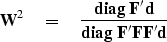 |
(38) |
 takes a vector
and lies it along the diagonal of a square matrix.)
The weight
takes a vector
and lies it along the diagonal of a square matrix.)
The weight  can be thought of as a diagonal matrix containing the ratio of two images.
A problem with the choice
(38) is that
the denominator might vanish or might even be negative.
The way to stabilize any ratio is suggested at the beginning of Chapter
can be thought of as a diagonal matrix containing the ratio of two images.
A problem with the choice
(38) is that
the denominator might vanish or might even be negative.
The way to stabilize any ratio is suggested at the beginning of Chapter
![[*]](http://sepwww.stanford.edu/latex2html/cross_ref_motif.gif) ; that is,
we revise the ratio a/b to
; that is,
we revise the ratio a/b to
 |
(39) |
 is a parameter to be chosen,
and the angle braces
indicate the possible need for local smoothing.
is a parameter to be chosen,
and the angle braces
indicate the possible need for local smoothing.
To go beyond the scaled adjoint we can use  as a preconditioner.
To use as a preconditioner
we define implicitly a new set of variables
as a preconditioner.
To use as a preconditioner
we define implicitly a new set of variables  by the substitution
  .Then
.Then  .To find instead of ,we do CD iteration
with the operator
.To find instead of ,we do CD iteration
with the operator  instead of with .As usual, the first step of the iteration is to use the adjoint
of
instead of with .As usual, the first step of the iteration is to use the adjoint
of  to form the image
 .At the end of the iterations,
we convert from back to with .The result after the first iteration
.At the end of the iterations,
we convert from back to with .The result after the first iteration
 turns out to be the same as Symes scaling.
By (38), has physical units inverse to .Thus the transformation has no units
so the variables have physical units of data space.
Experimentalists might enjoy seeing the
solution with its data units more than viewing the solution with its more theoretical model units.
The theoretical solution for underdetermined systems
 suggests
an alternate approach using instead
suggests
an alternate approach using instead
 .A possibility for
  is
is
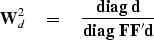 |
(40) |
Experience tells me that a broader methodology is needed.
Appropriate scaling is required in both data space and model space.
We need something that includes a weight for each space,
 and
and
 where
where
 .
.
I have a useful practical example (stacking in v(z) media)
in another of my electronic books (BEI),
where I found both
and
by iterative guessing.
But I don't know how to give you a general strategy.
I feel this is a major unsolved(?) opportunity.