


The original way in
Chapter ![[*]](http://sepwww.stanford.edu/latex2html/cross_ref_motif.gif) is to
restore missing data
by ensuring that the restored data,
after specified filtering,
has minimum energy, say
is to
restore missing data
by ensuring that the restored data,
after specified filtering,
has minimum energy, say
 .Introduce the selection mask operator
  ,
a diagonal matrix with
ones on the known data and zeros elsewhere
(on the missing data).
Thus
,
a diagonal matrix with
ones on the known data and zeros elsewhere
(on the missing data).
Thus
 or
or
 |
(27) |
 to be the data
with missing values set to zero by
to be the data
with missing values set to zero by
 .
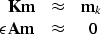
.A second way to find missing data is with the set of goals
 |
(28) |
 .At that limit, we should have the same result
as equation (27).
.At that limit, we should have the same result
as equation (27).
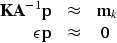
A third way to find missing data is to precondition
equation (28),
namely, try the substitution
 .
.
 |
(29) |
 and
if we are interested in
the limit we can simply forget about the
fitting goal
and
if we are interested in
the limit we can simply forget about the
fitting goal  .
.