


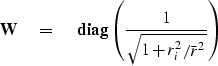
A good trick (I discovered accidentally) is to use the weight
 |
(16) |
 |
(17) |
 |
 .
.
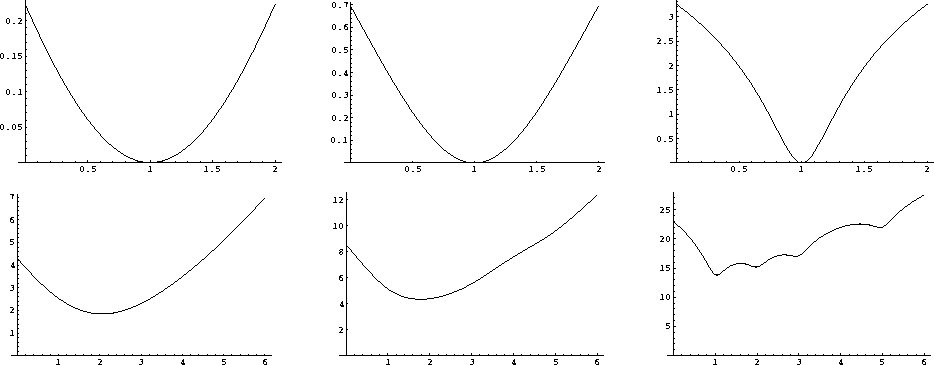
Because the second derivative is not positive everywhere,
the Cauchy function introduces the possibility of multiple solutions,
but because of the good results we see in Figure 4,
you might like to try it anyway.
Perhaps the reason it seems to work so well is that
it uses mostly residuals of ``average size,''
not the big ones or the small ones.
This happens because  is made from
  and
the components of
and
the components of  which are a function
 that is maximum for those residuals near
 .
.
Module irls ![[*]](http://sepwww.stanford.edu/latex2html/cross_ref_motif.gif) supplies two useful
weighting functions that can be interchanged as arguments to the
reweighted scheme .
supplies two useful
weighting functions that can be interchanged as arguments to the
reweighted scheme .
module irls {
  use quantile_mod
contains
  integer function l1 (res, weight)  {
    real, dimension (:)  :: res, weight
    real                 :: rbar
    rbar = quantile( int( 0.5*size(res)), abs (res))            # median
    weight = 1. / sqrt( sqrt (1. + (res/rbar)**2));   l1 = 0
    }
  integer function cauchy (res, weight)  {
    real, dimension (:)  :: res, weight
    real                 :: rbar
    rbar = quantile( int( 0.5*size(res)), abs (res))             # median
    weight = 1. / sqrt (1. + (res/rbar)**2);          cauchy = 0
    }
}


