Next: About this document ...
Up: Spectral factorization
Previous: THE KOLMOGOROFF METHOD
The principle of causality,
i.e., no response before a stimulus,
places certain restraints upon the nature of wave propagation.
Causality often seems to be violated because of
- 1.
- Approximations in a theory which are made to simplify it.
- 2.
- Fitting inappropriate curves to experimental observations.
- 3.
- Approximations made in converting differential equations to
difference equations.
Violations of causality often result
from seemingly inconsequential approximations
at spectral frequencies outside the range of practical interest.
The seemingly inconsequential approximations often take on significance
because of the very weak convergence in the Hilbert transform.
With regard to (1) and (2),
the violation of causality may turn out to be a low price
to pay compared with the cost of a more precise analysis.
With regard to (3) or computation in general,
the violation of causality usually has disastrous consequences.
Even though difference equations may have proper behavior
at frequencies of interest,
exponential growth at other frequencies is almost always so severe
as to completely obliterate the desired solution.
Most wave-propagation theories are worked out in the frequency domain
in homogeneous materials.
If they are further done in cartesian geometry,
the end result is that propagation along the x axis is given by
|  |
(23) |
What the wave theory provides is an expression for k in terms of frequency
and all the physical parameters such as velocity, viscosity, etc.
We will now take an ``after-the-derivation'' look at  and see if it satisfies causality.
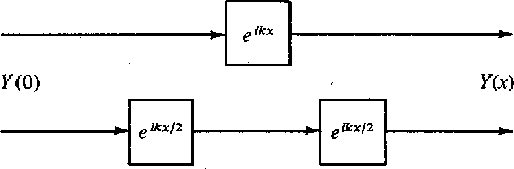
In other words, (23) is like the filter situation
depicted in Figure 7.
Y(0) is the filter input, Y(x) is like the output,
and eikx is a filter which models the effect of propagation.
The question is whether the filters are one-sided.
This depends upon the detailed form of .
and see if it satisfies causality.
In other words, (23) is like the filter situation
depicted in Figure 7.
Y(0) is the filter input, Y(x) is like the output,
and eikx is a filter which models the effect of propagation.
The question is whether the filters are one-sided.
This depends upon the detailed form of .
3-7
Figure 7
Modeling wave propagation with filters.
|
|  |

First, consider the simple case when is real for all real  .Then eikx is an all-pass filter.
It is realizable
if and only if
.Then eikx is an all-pass filter.
It is realizable
if and only if  is a monotonically increasing function
of .
is a monotonically increasing function
of .
Next, suppose is complex.
This means that attenuation will occur.
Clearly energy conservation requires that the real part of ikx be negative.
Define P(Z) to be a realizable all-pass filter and B(Z) to be a
realizable minimum-phase wavelet.
Any realizable function can be represented in the form B(Z) P(Z).
We will require eikx to be so represented.
| ![\begin{displaymath}
B(Z) P(Z) \eq e^{ikx} \eq \exp [i\, (k_r + ik_r) x]\end{displaymath}](img97.gif) |
(24) |
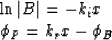
Taking logs and using  to denote phase, we have
|  |
(25) |
Splitting into real and imaginary parts we obtain
First of all, from the attenuation  we can by Hilbert
transform compute
we can by Hilbert
transform compute  .When it is subtracted from kr x we are
left with the phase shift
.When it is subtracted from kr x we are
left with the phase shift  of the all-pass filter.
Recall from Sec. 2-6 (on all-pass filters) that
if and only if is monotonically increasing,
we have a causal all-pass filter.
In conclusion, the test of causality for a function lies in computing
of the all-pass filter.
Recall from Sec. 2-6 (on all-pass filters) that
if and only if is monotonically increasing,
we have a causal all-pass filter.
In conclusion, the test of causality for a function lies in computing  and seeing whether it is monotonically increasing for all frequencies.
A great deal of confusion results from attenuation laws which are thought
to be of the form  (gaussian attenuation)
or
(gaussian attenuation)
or  (sometimes called constant Q).
The reason is that these functions are not integrable
so they do not have convergent Hilbert transforms;
that is,
the turns out to be infinite.
These functions correspond to time pulses
like the gaussian time function e-t2 which
do not have a time before which they are zero.
Such functions cannot strictly be considered
to be associated with any causal process;
however, they may give excellent practical approximations.
In reality, physical dissipation is generally associated
with a relaxation phenomenon having a finite relaxation time.
For frequency values below the relaxation value, the
attenuation may appear to be increasing indefinitely with frequency,
but, in fact, the attenuation decreases
above the characteristic relaxation frequency.
The attenuation also provides a phase velocity aberration
because of the addition of to but this is generally considered to be too small to measure.
(sometimes called constant Q).
The reason is that these functions are not integrable
so they do not have convergent Hilbert transforms;
that is,
the turns out to be infinite.
These functions correspond to time pulses
like the gaussian time function e-t2 which
do not have a time before which they are zero.
Such functions cannot strictly be considered
to be associated with any causal process;
however, they may give excellent practical approximations.
In reality, physical dissipation is generally associated
with a relaxation phenomenon having a finite relaxation time.
For frequency values below the relaxation value, the
attenuation may appear to be increasing indefinitely with frequency,
but, in fact, the attenuation decreases
above the characteristic relaxation frequency.
The attenuation also provides a phase velocity aberration
because of the addition of to but this is generally considered to be too small to measure.
Now let us take up an example of computer modeling of wave propagation.
The simplest example is propagation without dissipation.
Then  where v is the velocity.
Rather than attempt to construct a filter which
will carry waves a long distance
we will only attempt to carry them a distance
where v is the velocity.
Rather than attempt to construct a filter which
will carry waves a long distance
we will only attempt to carry them a distance  .The filter may be used N times to propagate a distance
 .We will use the bilinear truncation of the power series for exponential
| 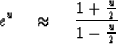 |
(26) |
and the bilinear representation for  , namely
| 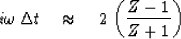 |
(27) |
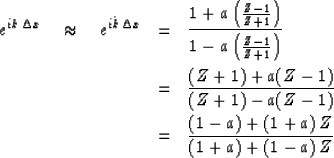
With these and and the definition  we obtain
|  |
|
| |
| (28) |
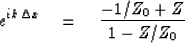
That this is the general form of an all-pass filter may be seen by taking
Z0 = -(1 + a)/(1 -a).
Then (28) becomes
|  |
(29) |
The denominator will be minimum phase and the all-pass filter will be
realizable if Z0 > 1 or  .This means that
present and past values of the inputs will determine the output if the wave
is being projected in the +x direction.
If it is desired to project
the wave backwards in space ( negative),
then
.This means that
present and past values of the inputs will determine the output if the wave
is being projected in the +x direction.
If it is desired to project
the wave backwards in space ( negative),
then  must be
taken negative, so that present and future input values determine the
present output.
must be
taken negative, so that present and future input values determine the
present output.
EXERCISES:
- What is the velocity error as a function of for the filter of
(28) for values of a = .1, 1., and 2. HINT:
Let
 so
so  .Then note that
Next: About this document ...
Up: Spectral factorization
Previous: THE KOLMOGOROFF METHOD
Stanford Exploration Project
10/30/1997