


A good on-line source for tips on authoring web pages is the section Authoring web pages, images and scripts at <http://www.boutell.com/faq>. The following example (See Figure 2) demonstrates the HTML constructs we typically choose when writing the SEP web pages:
<IMG ALIGN=right SRC="angst.gif" HEIGHT=56 WIDTH=50 ALT="[Fearful face]">
<H4>Shakespeare: Measure for Measure</H4>
Our doubts are traitors, <BR>
And make us lose the good we oft might win, <BR>
By fearing to attempt.
<HR>
<ADDRESS>
<A HREF="mailto:matt@sep.stanford.edu">matt@sep.stanford.edu</A>
</ADDRESS>
<!-#include virtual="/return2sep"->
</BODY>
</HTML>
<HTML>
<HEAD>
<TITLE>Shakespeare on doubts</TITLE>
<META NAME="keywords" CONTENTS="Shakespeare measure doubt">
</HEAD>
<BODY bgcolor="white">
|
angst
Figure 2 This example corresponds to the HTML skeleton that is discussed in the text. The HTML page contains a few invisible features. For example, the image is accompanied by a short statement that is displayed by text-only browsers. A keyword statement helps web search engines to catalog the page. | 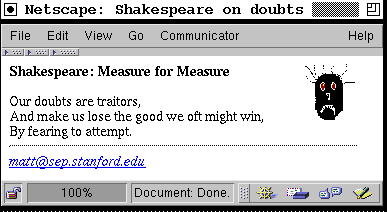 |

A browser may successfully render web pages even if the pages ignore some of the discussed HTML elements. Such negligence may, however, cause difficulties for web search engines, other browsers, or book-marks. Therefore, we recommend modeling new web pages on the above example.
 |
 |