


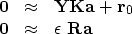
Instead of one PEF per patch, we estimate a PEF for every output data point; changing the problem from overdetermined to very underdetermined. We can estimate all these filter coefficients by the usual formulation, supplemented with some damping equations, say
 |
(1) |
 is a roughening operator,
  is convolution with the data, and
  is a known filter coefficient mask.
When the roughening operator is a differential operator,
the number of iterations can be large.
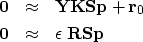
We can speed the calculation immensely and make the equations somewhat neater by ``preconditioning''.
When we define a new variable  by
by
 and insert it into (1) we get
 |
(2) | |
| (3) |
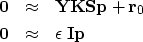
 by
by  and get
 |
(4) | |
| (5) |
using conjugate gradients.
To see  , we just use .
To reduce clutter, we could
drop the damping (5)
and keep only (2);
then to control the null space,
we need only to start
from a zero solution and limit the number of iterations.
As a practical matter,
without (5) we must find a good number of iterations and
with it we must find a good value for  .
.
For  we can use polynomial division by a Laplacian or by filters with a preferred direction.
If the data are CMP gathers, it is attractive to use radial filters, which are explained further down.
we can use polynomial division by a Laplacian or by filters with a preferred direction.
If the data are CMP gathers, it is attractive to use radial filters, which are explained further down.