


 media
media
tsg = ts+tg,
and therefore the gradient vector,
 is also in the direction that is normal to reflector dip, then is a scaled sum of the slownesses of the rays from the source
  and receiver
  to the specular point reflection. Therefore,
 |
(42) |


![\begin{displaymath}
p_{0z}=\cos[\theta(p_0,t_0)] s(t_0),\end{displaymath}](img164.gif)
![\begin{displaymath}
p_{sz}=\cos[\theta(p_s,t_s)] s(t_s),\end{displaymath}](img165.gif)
![\begin{displaymath}
p_{gz}=\cos[\theta(p_g,t_g)] s(t_g),\end{displaymath}](img166.gif)
 ; for each of , , and ) is the slowness and
  is the ray angle. Then
![\begin{displaymath}
\lambda = \frac{\cos[\theta(p_0,t_0)] s(t_0)}{\cos[\theta(p_s,t_s)] s(t_s)+\cos[\theta(p_s,t_s) s(t_s)}.\end{displaymath}](img169.gif) |
(43) |
Substituting equation (![[*]](http://sepwww.stanford.edu/latex2html/cross_ref_motif.gif) ) into the x-and y-components of
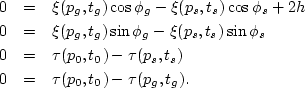
equation () provides two of the six nonlinear equations needed to be solved.
The other four equations are:
) into the x-and y-components of
equation () provides two of the six nonlinear equations needed to be solved.
The other four equations are:
 |
(44) | |
| (45) | ||
| (46) | ||
| (47) |
) is the requirement that the surface distances,  , along the inline component from both the source and receiver to the specular
reflection point (SRP) add to equal the source-receiver offset, 2h.
Equation () is the requirement that the distances
along the crossline component to the SRP are equal for the source and receiver.
Equations () and () imply that the vertical times,
, along the inline component from both the source and receiver to the specular
reflection point (SRP) add to equal the source-receiver offset, 2h.
Equation () is the requirement that the distances
along the crossline component to the SRP are equal for the source and receiver.
Equations () and () imply that the vertical times,  from the source, the receiver, and the zero-offset
surface positions to the SRP are equal.
Both and are calculated using ray tracing and
then stored in a table as a function of ray parameter p
and the traveltime t.
from the source, the receiver, and the zero-offset
surface positions to the SRP are equal.
Both and are calculated using ray tracing and
then stored in a table as a function of ray parameter p
and the traveltime t.
The inverse operator is calculated in the same way as the forward operator, but now we must calculate tn or the total traveltime tsg instead of t0, which is known. Subsequently, x0 and y0 are calculated in the same way as the forward approach.
To build the AMO operator, the output of the forward 3-DMO operator t0(tn,px,py), x0(tn,px,py), and y0(tn,px,py) are inserted into the inverse 3-D DMO operator. Prior to applying the inverse operator the axes are rotated with an angle given by the desired azimuth correction. The result is an AMO operator given by
tAMO[t0(tn,px,py),px,py],
xAMO(tn,px,py)=x0(tn,px,py)-x0,(t0,px,py),
andyAMO(tn,px,py)=y0(tn,px,py)-y0,(t0,px,py),
where x0, and y0, correspond to the adjoint (inverse) operator in the rotated domain. The rotation angle is the azimuth correction angle. |

Figure shows three AMO operators that correspond
to three different azimuth correction
angles in a v(z) medium. From left to right, the
azimuth correction angles are 15, 30, and 45 degrees, respectively.
The input and output offset are the same and equal to 2 km.
The root-mean-square (rms) velocity for
this model is similar to the homogeneous one and is equal to 2 km/s.
Interestingly, these operators
are very similar to the respective homogeneous ones.
The subtle differences, however,
will be apparent when we generate the residual AMO operators.
Though the shape of the AMO operator is practically
the same between the three corrections,
the size is very much dependent on the amount of azimuth
correction; the larger the azimuth angular correction
the larger the AMO operator.
This phenomenon occurs for homogeneous as well as v(z) media.
As a result,
we will use a single azimuth correction for most of the examples shown in this paper,
that is a 30 degrees azimuth correction.
 |
Figure shows an upper side and a top view of the 30-degrees
correction AMO operator
for the v(z) medium.
The saddle is
altered 30 degrees from the inline direction, in agreement with
the amount of azimuth correction applied.
The AMO operator domain has an overall circular shape.
The shape of our AMO domain appears to be different from
the one presented by () (a parallelogram),
because we limit the zero-offset ray parameters
when plotting the AMO operator.