


The 3-D prestack DSR operator in frequency and wave number domain is (, )
![\begin{eqnarray}
DSR(K_{m},K_{h},z,\omega)=\sqrt{\frac{w^2}{v_{(mS,z)}^2} +
\fra...
...v_{(mG,z)}^2} +
\frac{1}{4}[(K_{mx}+K_{hx})^2+(K_{my}+K_{hy})^2]},\end{eqnarray}](img129.gif) |
||
| (34) |
Alkhalifah (1997) derives the dispersion equation for transversely anisotropic media. He assumes that the vertical S-wave velocity is equal to zero (VS0=0) and that the dispersion relation for the 3-D prestack DSR can be rewritten in a more general equation as follows:
![\begin{eqnarray}
&&DSR(K_{m},K_{h},z,\omega)=K_{z}= \nonumber \\ &&
\frac{v_{(m...
...
(\frac{v_{(mG,z)}}{w})^2[(K_{mx}+K_{hx})^2+(K_{my}+K_{hy})^2]})},\end{eqnarray}](img130.gif) |
||
| (35) |
 the vertical velocity (Vv) is equal to the migration
velocity, there is no problem plotting the results in the depth
coordinate.
the vertical velocity (Vv) is equal to the migration
velocity, there is no problem plotting the results in the depth
coordinate.
Equation (![[*]](http://sepwww.stanford.edu/latex2html/cross_ref_motif.gif) ) is expressed in pseudo-depth by the
following equation:
) is expressed in pseudo-depth by the
following equation:
 |
(36) |
Rewriting the DSR equation equation () in
pseudo-depth ( ) for the 2-D case, we have :
 |
(37) |
), gives the DSR used in a 3-D prestack depth
migration () as follows:
![\begin{eqnarray}
&&DSR(k_{m},k_{h},z,\omega) \cong \nonumber \\ &&\frac{v_{(mS,z...
...ft(\frac{\omega}{v_{(mG,z)}} -
\frac{\omega}{v_{Gref(z)}}\right)].\end{eqnarray}](img133.gif) |
||
| (38) |
Equation () shows that in anisotropic media, the
split-step approximation is obtained by assuming that  is
constant for every depth step. In the seismic synthetic examples that
I show in the results section, I use two different approaches to
migrate the anisotropic Marmousi data set. In the first approach, I
use a constant . In
the second approach I define a number of reference 's, in order to
obtain a better migrated image of the dipping reflectors.
This is an approach that gives impressive results but
it should be generalized to handle lateral variations, where
variations are the velocity variation.
is
constant for every depth step. In the seismic synthetic examples that
I show in the results section, I use two different approaches to
migrate the anisotropic Marmousi data set. In the first approach, I
use a constant . In
the second approach I define a number of reference 's, in order to
obtain a better migrated image of the dipping reflectors.
This is an approach that gives impressive results but
it should be generalized to handle lateral variations, where
variations are the velocity variation.
Other possible solution to include lateral variation is using
different 's defined in the same fashion that reference
velocities are defined but migrate
with just one reference velocity (Alkhalifah 1998, personal communication).
(), assuming that the vertical S-wave velocity is
equal to zero vS0=0, introduce an anisotropic parameter called
. This anisotropic parameter can be written as a
function of Thomsen's parameters ( and
and  ) as
follows:
) as
follows:
 |
(39) |
In this paper I set to avoid working with the ratio of the
vertical velocity and migration velocity in equation
().
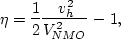
The variable is expressed as a function of the NMO velocity
(VNMO) as follows:
 |
(40) |
 and VNMO=vv, where VNMO is short spread
NMO velocity. This parameter contains the information about
the ratio between the horizontal velocity vh and vertical
velocity.
and VNMO=vv, where VNMO is short spread
NMO velocity. This parameter contains the information about
the ratio between the horizontal velocity vh and vertical
velocity.