


Fourier Transform input data
Loop over frequency {
     Initialize wave at z=0
     Factor wave equation for this w/v
     Recursively divide input data by factor
     Fourier Transform back to time-domain
     Sum into output
}
Incorporating this code into the Wavemovie
program Claerbout (1985) provides a laboratory for testing the new
algorithm.
Figure 3 compares the results of the new extrapolation
procedure with the conventional Crank-Nicolson solution to the
45 equation. The new approach has little dispersion since we
are using a rational approximation (the `one-sixth trick') to the
Laplacian on the vertical and horizontal axes. In addition, the new
factorization retains accuracy up to 90. The high dip,
evanescent energy in the 45 movie, propagates correctly in the
new approach.
equation. The new approach has little dispersion since we
are using a rational approximation (the `one-sixth trick') to the
Laplacian on the vertical and horizontal axes. In addition, the new
factorization retains accuracy up to 90. The high dip,
evanescent energy in the 45 movie, propagates correctly in the
new approach.
|
vs45
Figure 3 Comparison of the 45 wave equation
(left) with the helical factorization of the Helmholtz equation
(right).
| 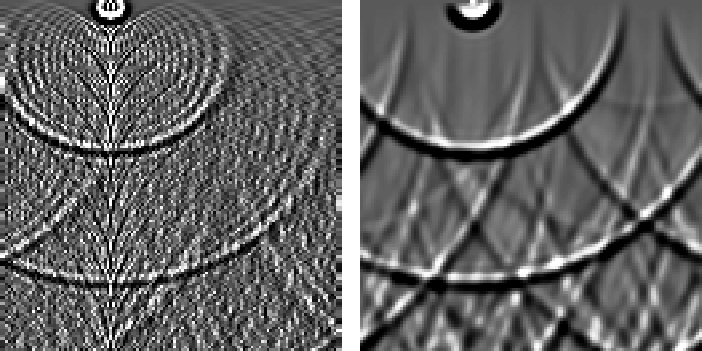 |


Figure 4 compares different value of the `one-sixth'
parameter,  . For this application, the optimal value seems to
be
. For this application, the optimal value seems to
be  .
.
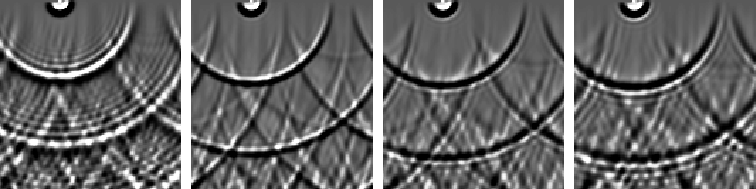 |
. From left,
 0, 1/12, 1/8 and 1/6.
Figure 5 compares different  finite-difference filters.
  corresponds to the conventional
5-point filter, while corresponds to a rotated 5-point
filter. Values in the range
corresponds to the conventional
5-point filter, while corresponds to a rotated 5-point
filter. Values in the range  correspond to 9-point
filters that are linear combinations of the above. Best results are
obtained with
correspond to 9-point
filters that are linear combinations of the above. Best results are
obtained with  . The impulse response with only contains energy on every second grid point, since the rotated
filter only propagates energy diagonally: as in the game of a chess,
if a bishop starts on a white square, it always stays on white.
. The impulse response with only contains energy on every second grid point, since the rotated
filter only propagates energy diagonally: as in the game of a chess,
if a bishop starts on a white square, it always stays on white.
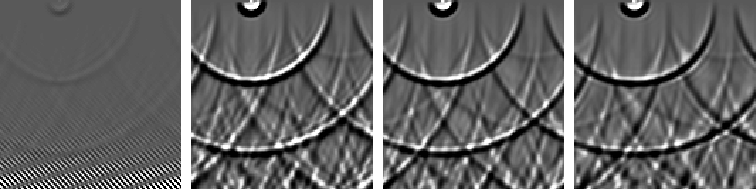 |
finite-difference representations of the
Laplacian. From left,  0, 1/2, 2/3 and 1.