


 equation is shown in Figure 1. As with the 2-D
implementation of the 45 equation, evanescent energy at high
dip appears as noise, and takes the form of a cardioid. This is never a
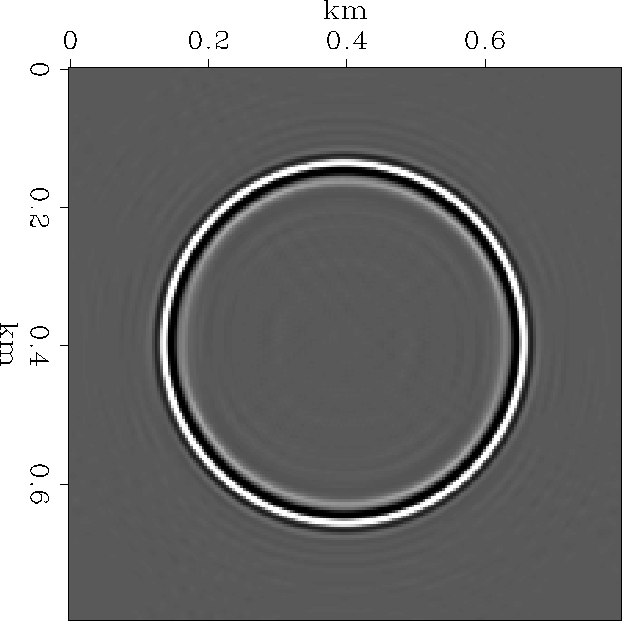
problem on field data, and has been removed from the depth-slice shown
in Figure 2.
Implicit migration with the full Laplacian, instead of a splitting
approximation, produces an impulse response that is azimuthally
isotropic without the need for any phase corrections.
equation is shown in Figure 1. As with the 2-D
implementation of the 45 equation, evanescent energy at high
dip appears as noise, and takes the form of a cardioid. This is never a
problem on field data, and has been removed from the depth-slice shown
in Figure 2.
Implicit migration with the full Laplacian, instead of a splitting
approximation, produces an impulse response that is azimuthally
isotropic without the need for any phase corrections.
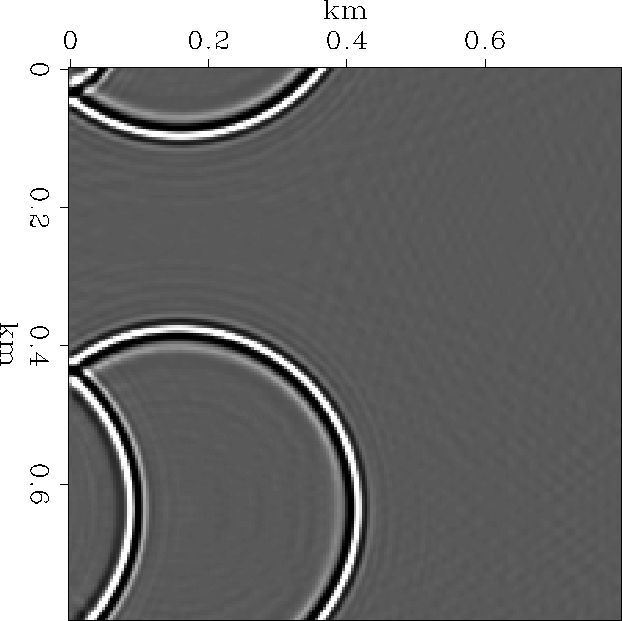
Figure 3 shows the effects of the different boundary conditions on the two spatial axes. The fast spatial axis (top and bottom of Figure) have helical boundary conditions, and show wrap-around. The slow spatial axis (left and right of Figure) has a zero-value boundary condition, and hence is reflective.
For the examples in this paper, we set the `one-sixth'
parameter Claerbout (1985),  , and used the isotropic
nine-point Laplacian from equation (8).
, and used the isotropic
nine-point Laplacian from equation (8).
|
3Dtimeslice
Figure 2 Depth-slice of centered impulse response corresponding to a dip of 45 . Note the azimuthally isotropic nature of the
full implicit migration. Evanescent energy has been removed by
dip-filtering prior to migration.
|  |


|
3Dboundary
Figure 3 Depth-slice of offset impulse response corresponding to a dip of 45 . Note the helical boundary conditions on the fast spatial axis.
|  |