


Next: ACKNOWLEDGEMENT
Up: NOTES FROM TIEMAN's SEMINAR
Previous: The midpoint gather
Fortunately, we can convert this common-midpoint transform (9) into
an equivalent common-source transform (6).
Let us make two additional Fourier transforms over spatial dimensions
of s and y for the spatial frequencies ks and ky:
|  |
|
| (10) |
and
|  |
|
| (11) |
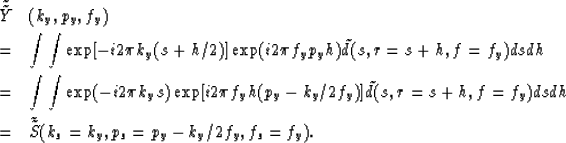
To place the second integral (11) in the form of the
first (10), we should change the variables of integration
from h and y to h and s. (The Jacobian of this transformation
is  .) Substituting y=s+h/2 we get
|  |
|
| |
| |
| (12) |
Thus, a two-dimensional stretch of the midpoint-gather transform
becomes equivalent to the source-gather transform.
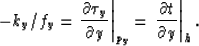
For a given dip over offset in a midpoint gather
py, we can identify a dip over midpoint
|  |
(13) |
The adjustment of ps = py - ky/2fy subtracts
half of this midpoint dip from the offset dip.
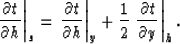
With a careful application of the chain rule, and carefully
distinguishing partial derivatives, we could arrive at the
same result
|  |
(14) |
Next: ACKNOWLEDGEMENT
Up: NOTES FROM TIEMAN's SEMINAR
Previous: The midpoint gather
Stanford Exploration Project
11/12/1997