Next: Wave field extrapolation into
Up: The forward model
Previous: Propagation operators
The property of the angle-dependent
reflectivity matrix R(zn) in equation (![[*]](http://sepwww.stanford.edu/latex2html/cross_ref_motif.gif) )
becomes clearer if we look at it in the Fourier domain
as de Bruin et al. (1990) does.
In order to obtain an expression for
)
becomes clearer if we look at it in the Fourier domain
as de Bruin et al. (1990) does.
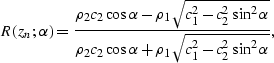
In order to obtain an expression for  ,we start with the well-known angle-dependent reflection
coefficient
,we start with the well-known angle-dependent reflection
coefficient  for two acoustic half-spaces separated
by an interface at zn:
for two acoustic half-spaces separated
by an interface at zn:
|  |
(44) |
where c1 and c2 are the velocities,
 and
and  are the mass densities
of the upper and lower half-space, respectively,
and
are the mass densities
of the upper and lower half-space, respectively,
and  is the angle of incidence.
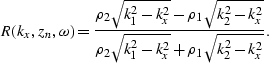
By substituting
is the angle of incidence.
By substituting  ,
,  , and
, and
 into equation () we obtain
|  |
(45) |
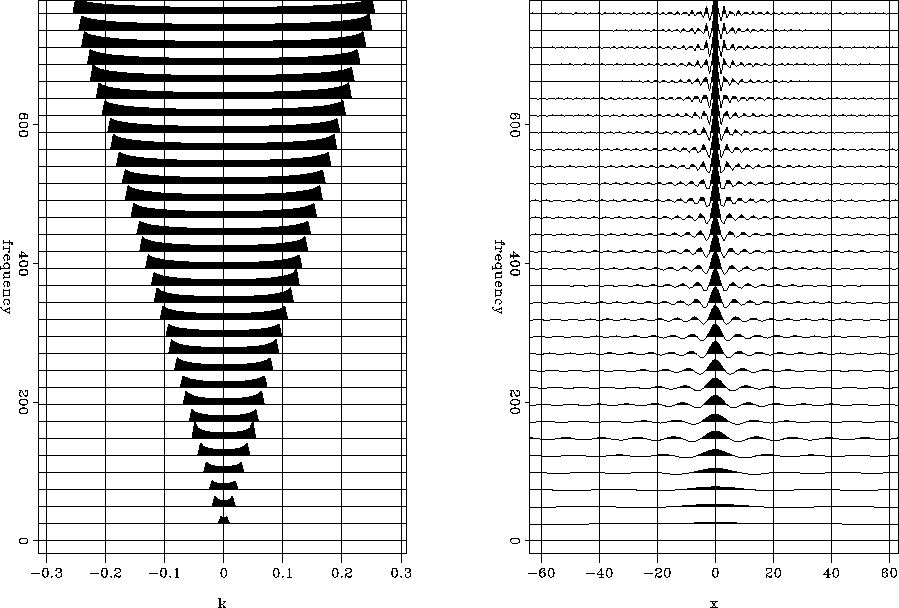
As an example, Figure shows the angle-dependent
reflection coefficients in the  and
and
 domains when c1=1500 m/s, c2=3000 m/s,
 , and
, and  .Since the reflection is a convolution of the downgoing wave field
with the reflection coefficient,
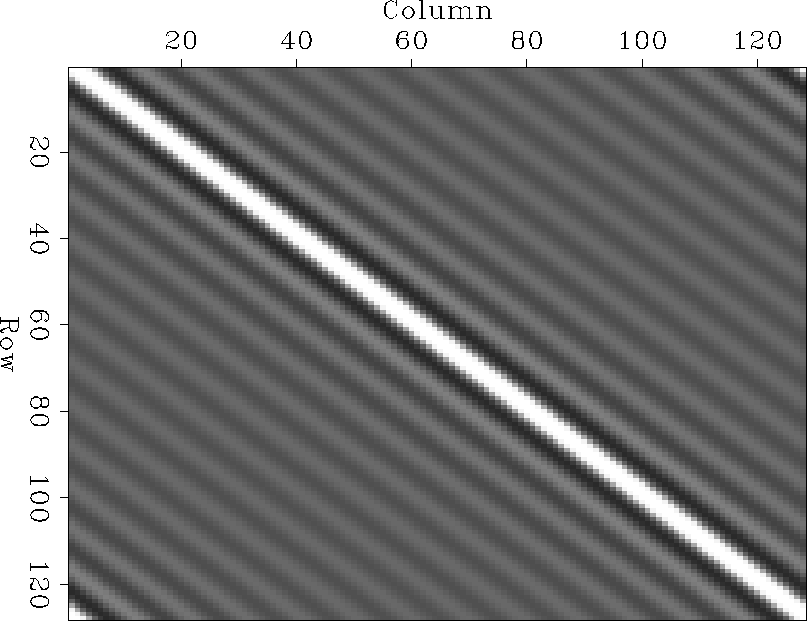
the reflectivity matrix in equation ()
can be visualized by taking the reflection coefficient for a given
frequency in Figure and making a matrix
whose columns are down-shifted reflection coefficients of
each other.
Figure shows this reflectivity matrix
when
.Since the reflection is a convolution of the downgoing wave field
with the reflection coefficient,
the reflectivity matrix in equation ()
can be visualized by taking the reflection coefficient for a given
frequency in Figure and making a matrix
whose columns are down-shifted reflection coefficients of
each other.
Figure shows this reflectivity matrix
when  .
.
rc-wk-wx
Figure 1 Angle-dependent reflection coefficients in (left) and (right) domains when c1=1500 m/s, c2=3000 m/s,, and .


rc-mat
Figure 2 Reflectivity matrix R for . |
|  |
Next: Wave field extrapolation into
Up: The forward model
Previous: Propagation operators
Stanford Exploration Project
2/5/2001