


The images obtained by synthesizing plane waves can be handled
in two ways, stacking or patching, according to the purpose of imaging.
If one is interested in structure imaging, the stacking of all the images
that were obtained by synthesizing different plane waves
is helpful because it enhances the image quality
by constructive interference
where the reflector is and reduces noises by destructive interference.
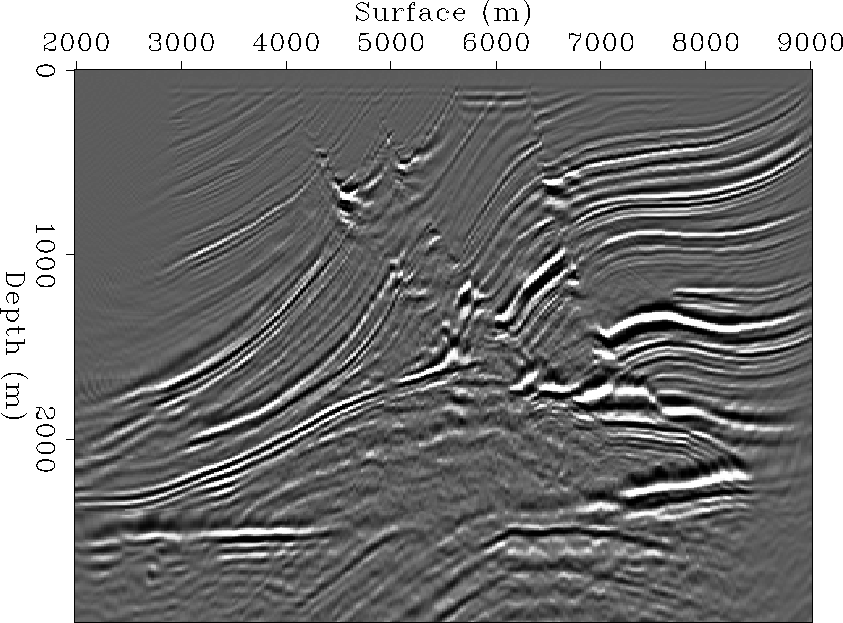
Figure ![[*]](http://sepwww.stanford.edu/latex2html/cross_ref_motif.gif) shows the result of image stacking
with thirty-one plane waves synthesized at the surface, where the
incidence angle changes from -30 degrees to 30 degrees.
Comparing this to the image obtained by synthesizing a single plane-wave
at the surface (Figure ), we can see a significant
improvement in the quality of reflector images.
shows the result of image stacking
with thirty-one plane waves synthesized at the surface, where the
incidence angle changes from -30 degrees to 30 degrees.
Comparing this to the image obtained by synthesizing a single plane-wave
at the surface (Figure ), we can see a significant
improvement in the quality of reflector images.
On the other hand, if one is interested in the angle-dependent
reflectivity recovery or prestack velocity estimation,
each image obtained by synthesizing different plane waves
should be saved separately because each image contains different
information.
Even in the image obtained by the synthesis of a plane-wave,
only the portion of the image where the plane-wave was synthesized
is interpretable because the plane-wave will be distorted
after propagation through a complex velocity medium
and we do not know the incidence angle of the distorted
plane-wave at each depth unless we perform exhaustive ray-tracing.
Therefore, I patched the interpretable parts of
images obtained by synthesizing a plane-wave at different depths
to produce common-incidence angle images.
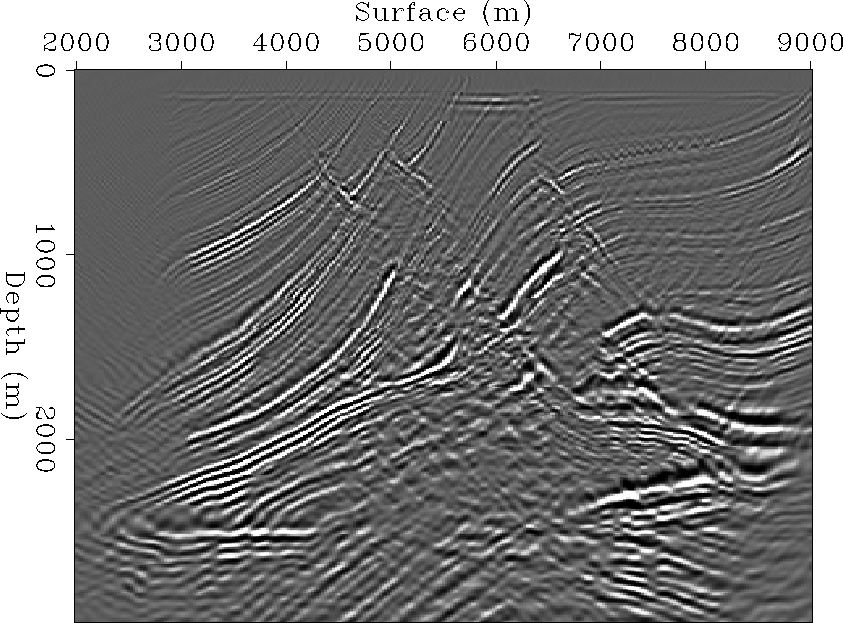
For example, Figure shows the image obtained
by patching twenty-one images obtained by synthesizing plane waves ( 0 degrees )
at twenty-one equi-spaced depth levels.
Comparing this to the image obtained by synthesizing a plane-wave
at the surface (Figure ), we can observe
that the quality of images is almost the same in the entire section,
unlike Figure , where the quality of image
significantly changes from place to place.
 |


 |