


Figure ![[*]](http://sepwww.stanford.edu/latex2html/cross_ref_motif.gif) shows the results of using equation ()
to predict the noise from the data from Figure .
Notice that the result is significantly better than that shown in
Figure ,
although some artifacts are seen near the first breaks.
Almost no noise is seen in the signal section.
shows the results of using equation ()
to predict the noise from the data from Figure .
Notice that the result is significantly better than that shown in
Figure ,
although some artifacts are seen near the first breaks.
Almost no noise is seen in the signal section.
While the program using the 2-D filter version of equation ()
with the initial solution of zero required 250 iterations
to get a reasonable result,
the program using the initialized estimate needed only 25.
Figure shows the results of using equation ()
to predict the signal from the data seen in Figure .
The separation is also good,
and only a little weakening of the data traces can be seen
where the noise appears.
A little of the signal that has not been perfectly predicted
has leaked into the noise section.
An improved result might
be produced by using the output of this process as the input to another
step of the same process, with the next step using the previous step's
results as the first guess of the amplitude and noise. The new
noise and amplitude scale factors might then be more accurate.
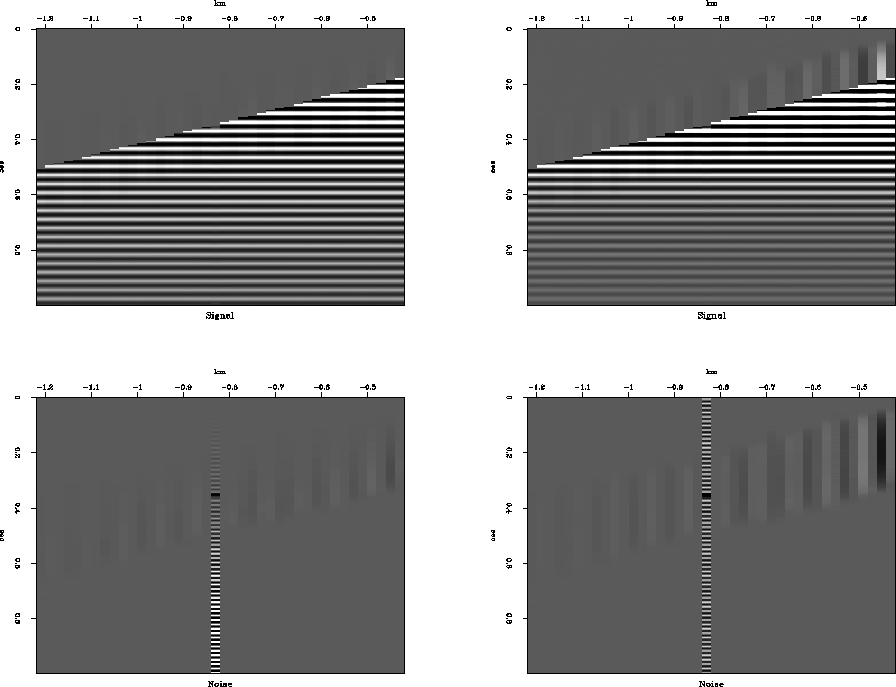 |
) was used.
The plot on the top is the calculated signal, and the plot on the
bottom is the noise that remained.
The plot on the left has t2 scaling, the plot on the right does not.


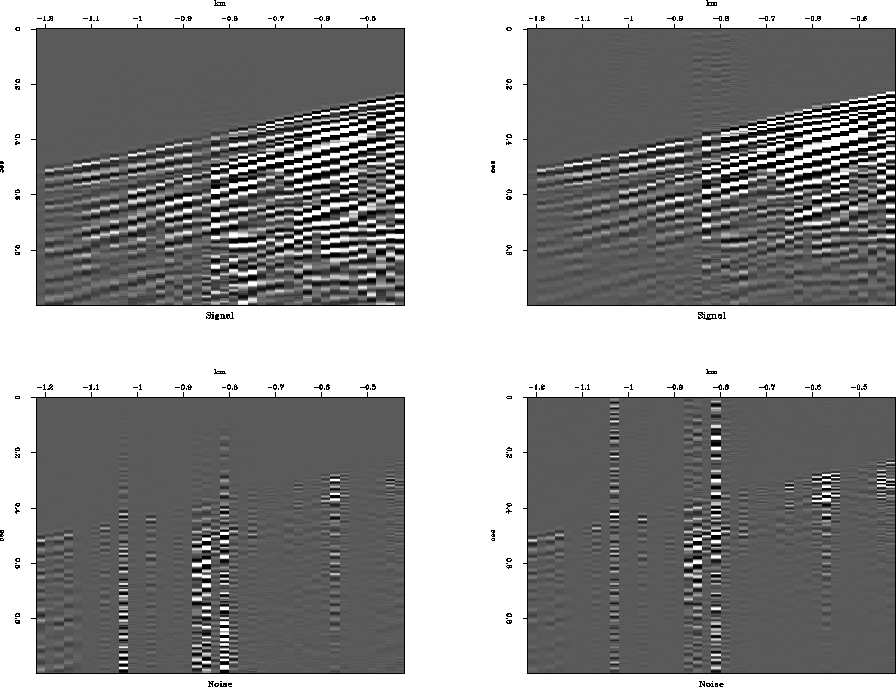 |
) was used.
The plot on the top is the calculated signal, and the plot on the
bottom is the noise that remained.
The plot on the left has t2 scaling, the plot on the right does not.