![[pdf]](icons/pdf.png)
|
|
|
|
| Subsalt imaging by target-oriented wavefield least-squares migration: A 3-D field-data example | |
|
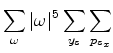
As derived in Appendix A, each component of the the 3-D conical-wave domain Hessian reads
 is the source signature at frequency
  ;
;
 and
and  are the source locations in the inline and crossline directions, respectively;
 is the receiver location;
 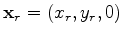 is the horizontal component of the source ray parameter;
 is the acquisition mask operator, which contains ones where we record data, and zeros
where we do not; and
is the acquisition mask operator, which contains ones where we record data, and zeros
where we do not; and
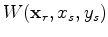 and
and
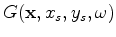 are the Green's functions
connecting the source and receiver positions to the image point
are the Green's functions
connecting the source and receiver positions to the image point
 , respectively.
The diagonal part of the Hessian (when
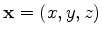 ), which contains autocorrelations
of both source and receiver-side Green's functions, can be interpreted as a subsurface illumination
map with contributions from both sources and receivers. The rows of the Hessian (for fixed
), which contains autocorrelations
of both source and receiver-side Green's functions, can be interpreted as a subsurface illumination
map with contributions from both sources and receivers. The rows of the Hessian (for fixed  's
and varying
's
and varying  ), which contains crosscorrelations of both source and receiver-side Green's
functions, can be interpreted as resolution functions (Tang, 2009; Lecomte, 2008). They measure
how much smearing an image can have due to a given acquisition setup.
), which contains crosscorrelations of both source and receiver-side Green's
functions, can be interpreted as resolution functions (Tang, 2009; Lecomte, 2008). They measure
how much smearing an image can have due to a given acquisition setup.
The exact Hessian defined by equation 3, however, is nontrivial and very expensive to implement.
It requires either storing a huge number of Green's functions for reuse, or performing
a large number of wavefield propagations to repeatedly calculate the Green's functions, resulting in
a computational cost proportional to
 , with
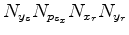 ,
,  ,
,  and
and  being the number of crossline shots,
inline conical waves, inline receivers and crossline receivers, respectively.
being the number of crossline shots,
inline conical waves, inline receivers and crossline receivers, respectively.
In order to reduce the computational cost,
we use the simultaneous phase-encoding technique to efficiently
calculate an approximate version of equation 3.
The simultaneous phase-encoding, however, is only strictly valid when the
acquisition
mask operator is independent along the encoding axes (Tang, 2009).
For the 3-D conical-wave-domain Hessian, the encoding axes are the inline source axis and the
receiver axis
 , respectively.
Ocean-bottom cable (OBC) and land acquisition geometries, where receivers are fixed for all sources, obviously
satisfy this condition. But marine-streamer acquisition geometry, where the receiver cable moves with sources,
apparently does not.
To make the theory applicable to the marine-streamer data case,
we assume that the receiver location
, respectively.
Ocean-bottom cable (OBC) and land acquisition geometries, where receivers are fixed for all sources, obviously
satisfy this condition. But marine-streamer acquisition geometry, where the receiver cable moves with sources,
apparently does not.
To make the theory applicable to the marine-streamer data case,
we assume that the receiver location 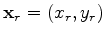 depends only on the crossline source position ,
but is independent of the inline source position .
This implicitly assumes that for a fixed crossline , all inline shots share the same receiver array.
Therefore, we can express the acquisition mask operator as a product of two separate functions:
depends only on the crossline source position ,
but is independent of the inline source position .
This implicitly assumes that for a fixed crossline , all inline shots share the same receiver array.
Therefore, we can express the acquisition mask operator as a product of two separate functions:
 and
and  define the distributions of receiver position and the inline source position ,
respectively, for a given crossline source position .
define the distributions of receiver position and the inline source position ,
respectively, for a given crossline source position .
Substituting equation 4 into equation 3 yields
 is the receiver-side encoding function, to be specified later.
Equation 6 can be greatly simplified as follows:
is the receiver-side encoding function, to be specified later.
Equation 6 can be greatly simplified as follows:
 and
and  can be obtained by solving the following one-way wave equations:
 is the velocity at image point ,
 is the Laplacian operator, and
 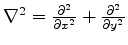 is the Dirac delta function.
Therefore, is the wavefield generated by propagating the conical-wave source
is the Dirac delta function.
Therefore, is the wavefield generated by propagating the conical-wave source
 , whereas
is the wavefield generated by propagating the encoded-area source
, whereas
is the wavefield generated by propagating the encoded-area source
 .
It is quite obvious that the computational cost of equation 7 is independent of the number of receivers, as
opposed to equation 3, for which the cost is proportional to the number of receivers.
.
It is quite obvious that the computational cost of equation 7 is independent of the number of receivers, as
opposed to equation 3, for which the cost is proportional to the number of receivers.
However, the phase-encoded Hessian brings unwanted crosstalk. This becomes clear by comparing equations 6
and 3. The crosstalk can be suppressed by carefully choosing the phase-encoding function (Tang, 2009).
In this paper, we choose to be a random phase-encoding function; thus  denotes the realization index of the random phase-encoding function.
It would be very easy to verify that, with this choice of encoding functions, the expectation of the crosstalk becomes zero.
Therefore,
equation 6 converges
to equation 5 by stacking over , according to the law of large numbers (Gray and Davisson, 2003):
denotes the realization index of the random phase-encoding function.
It would be very easy to verify that, with this choice of encoding functions, the expectation of the crosstalk becomes zero.
Therefore,
equation 6 converges
to equation 5 by stacking over , according to the law of large numbers (Gray and Davisson, 2003):
 |
(12) |
|
|
|
|
| Subsalt imaging by target-oriented wavefield least-squares migration: A 3-D field-data example | |
|