


![[pdf]](icons/pdf.png)
|
|
|
|
| Generalized-norm conjugate direction solver | |
|
| Norm | Description | |
| L2 | Conventional  norm, utilizing the new solver framework norm, utilizing the new solver framework |
|
| L1 |  norm with discontinuous norm with discontinuous  and and  order derivatives order derivatives |
|
| Huber | Huber / norm with with order derivative continuity |
|
| Hybrid | / hybrid norm with and order derivative continuity |
 represent the norm function, its first-order derivative and its second-order derivative, respectively.
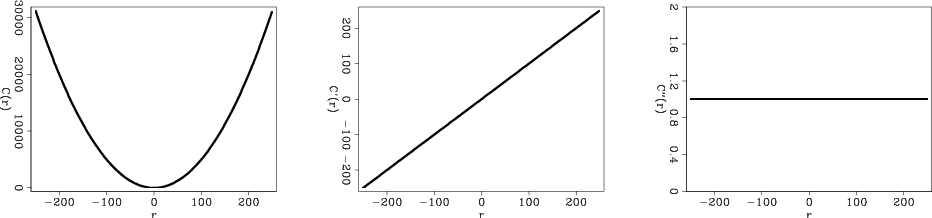
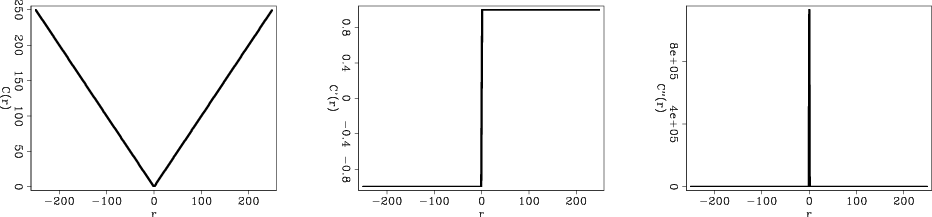
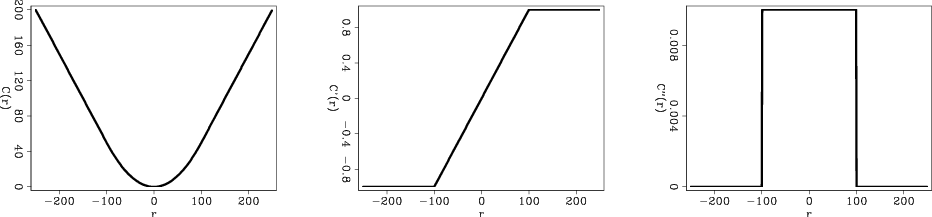
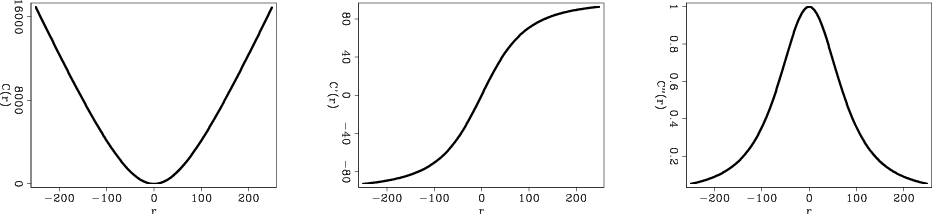
Figure 1 shows these norm functions along with their derivatives. Note discontinuous derivatives and zero-valued curvatures in some cases. These analytical forms are used in the Taylor series expansion for the adapted conjugate-direction plane-search.
represent the norm function, its first-order derivative and its second-order derivative, respectively.
Figure 1 shows these norm functions along with their derivatives. Note discontinuous derivatives and zero-valued curvatures in some cases. These analytical forms are used in the Taylor series expansion for the adapted conjugate-direction plane-search.
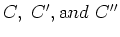
L2 (Least Squares):
 |
 |
 |
(1) |
 |
|
 |
(2) |
 |
|
 |
(3) |
L1:
|
|
 |
(4) |
|
|
 |
(5) |
|
|
0 or |
(6) |
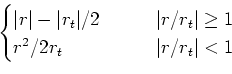
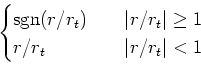
Huber:
|
|
 |
(7) |
|
|
 |
(8) |
|
|
 |
(9) |
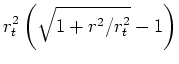
Hybrid:
|
|
 |
(10) |
|
|
 |
(11) |
|
|
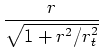 |
(12) |
|
|---|
|
l2-norm,l1-norm,huber-norm,hybrid-norm
Figure 1. Norm functions and their first and second derivatives plotted for 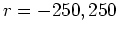 interval, with interval, with  where applicable. Rows from top to bottom are representing (a), (b) , (c) Huber, and (d) Hybrid. Columns from left to right are representing norm function, first-order derivative, second-order derivative. [ER] where applicable. Rows from top to bottom are representing (a), (b) , (c) Huber, and (d) Hybrid. Columns from left to right are representing norm function, first-order derivative, second-order derivative. [ER]
|
|
|
The choice of norm is specified as an input argument to our solver. A further benefit of this implementation is that other norms can be added with minimal modification to the overall solver framework. To add a new norm, all that is necessary is adding the appropriate definition of the norm and its derivatives in the code.
|
|
|
|
| Generalized-norm conjugate direction solver | |
|