![[pdf]](icons/pdf.png)
|
|
|
|
| Dix inversion constrained by L1-norm optimization | |
|
 hybrid method
Extending the discussion in last section, many authors
(Claerbout, 2009; Bube and Langan, 1997) generalize the optimization
problem of Dix inversion. Claerbout (2009) points out that any arbitrary
norm  can be used as a penalty function. Then the optimization
problem can be written as:
can be used as a penalty function. Then the optimization
problem can be written as:
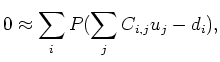 is a convex function of a scalar,
  ,
,  , and
, and
 are elements in the causal integration operator
  , the model
 and the known data
  .
.
We have special interests in an hybrid norm, because instead of
a sharp transition, this norm provides a smooth transition between
 and
and  . This can be shown in the formulation of the hybrid
norm:
. This can be shown in the formulation of the hybrid
norm:
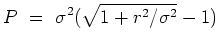 is the data residual and
  is the same threshold as
in last section, and thus can be chosen according to the same physical
explanation. The hybrid norm approaches
the least squares limit as
is the same threshold as
in last section, and thus can be chosen according to the same physical
explanation. The hybrid norm approaches
the least squares limit as
 and approaches the
limit as
and approaches the
limit as
 .
.
The first and the second derivative of this hybrid
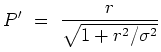
norm with respect to the residuals are given in equation 11
and equation 12. We can see the penalty function
transits from to smoothly at  since the first
derivative is continuous.
since the first
derivative is continuous.
Claerbout (2009) also proposed a new method based on Taylor's series to search the plane spanned by the gradient and the previous step. He embedded the new iterative bivariate solver in a conjugate direction solver, hoping for significant savings by expending more effort to find a better next step. In this experiment, we use the solver coded by Maysami and Mussa (2009), who adapt Claerbout's theory. For more information, refer to these two papers.
|
|
|
|
| Dix inversion constrained by L1-norm optimization | |
|