![[pdf]](icons/pdf.png)
|
|
|
|
| Dix inversion constrained by L1-norm optimization | |
|
Bube and Langan (1997) and Tang (2006) show that the
nonlinear objective functions, such as the regression equation
(3), can be solved by the IRLS algorithm. Many authors have
demonstrated successful applications of IRLS as a robust estimator to
yield sparse models. To take advantage of the well-established  norm regression, we can transform the problem by introducing a
diagonal weighting function
norm regression, we can transform the problem by introducing a
diagonal weighting function
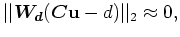
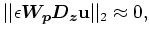
 . Then the fitting goal
2 and the regularization 3 become:
. Then the fitting goal
2 and the regularization 3 become:
is a diagonal weighting function on the model
residual. To use the gradient-based method, we have to recompute the
weight
at each iteration, and the algorithm can be
summarized as follows:
 to equal the identity matrix:
 |
(6) |
 iteration, the
  element of the weighting
matrix is recomputed as
element of the weighting
matrix is recomputed as
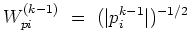 is the model residual.
However, applying equation (7) to compute the weighting
matrix is dangerous when
is the model residual.
However, applying equation (7) to compute the weighting
matrix is dangerous when  is zero or too small. One way to avoid
this issue is to bound the weights at a certain cutoff
is zero or too small. One way to avoid
this issue is to bound the weights at a certain cutoff  :
:
One of the most important disadvantages of IRLS algorithm arises in
equation 8: how should we choose the cutoff number
? We would like to derive this number automatically according
to its physical meaning, instead of cumbersome numerical experiments.
Further examining the weighting function, we notice that when applying
the truncated weights, we end up treating small residuals in the
norm, and at the turning point ( ) we have a sharp transition
to the
) we have a sharp transition
to the  norm. Thus, is the cutoff between the region
and the region, determining the tolerance to the large
residuals. Therefore, we can choose according to the desired
blockiness of the model space. For the synthetic example, which is a
40-point-long interval velocity model with three layers, we expect
only two spikes out of those 40 points in the derivative. Therefore we
would like to be around the
norm. Thus, is the cutoff between the region
and the region, determining the tolerance to the large
residuals. Therefore, we can choose according to the desired
blockiness of the model space. For the synthetic example, which is a
40-point-long interval velocity model with three layers, we expect
only two spikes out of those 40 points in the derivative. Therefore we
would like to be around the  percentile of the
derivative, allowing 5% of the spikes to be of unlimited size, while
the others are small.
percentile of the
derivative, allowing 5% of the spikes to be of unlimited size, while
the others are small.
|
|
|
|
| Dix inversion constrained by L1-norm optimization | |
|