


![[pdf]](icons/pdf.png)
|
|
|
|
| Target-oriented joint inversion of incomplete time-lapse seismic data sets | |
|
 is obtained by the action of a modeling operator
  on the earth reflectivity
  :
:
Given two data sets (baseline and monitor), acquired over an evolving earth model at times  and
and  respectively, we can write
 and
and
 are the baseline and monitor reflectivities, and
 and
and
 are the data sets modeled by
 and
and
 .
.
Applying the adjoint operators
 and
and
 to
and
respectively, we obtain the migrated baseline
to
and
respectively, we obtain the migrated baseline
 and monitor
 images:
 denotes conjugate transpose of
 .
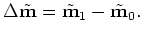
The raw time-lapse image
.
The raw time-lapse image
 is the difference between the migrated images:
Because incomplete seismic data sets leads to high non-repeatability,
 and
and
 must be cross-equalized before
 is computed.
The high level of non-repeatability makes it difficult to adapt existing cross-equalization methods (Rickett and Lumley, 2001; Calvert, 2005; Hall, 2006) to randomly sampled time-lapse seismic data sets.
The RJMI method takes the data acquisition geometry and sampling into account and hence can correct for the non-repeatability of the data sets.
is computed.
The high level of non-repeatability makes it difficult to adapt existing cross-equalization methods (Rickett and Lumley, 2001; Calvert, 2005; Hall, 2006) to randomly sampled time-lapse seismic data sets.
The RJMI method takes the data acquisition geometry and sampling into account and hence can correct for the non-repeatability of the data sets.
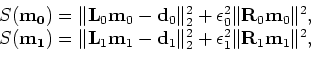
We define two quadratic cost functions for the modeling experiments (equation 2):
 and
and
 , where
 denotes approximate inverse.
Because seismic inversion is ill-posed, model regularization is often required to ensure stability and convergence to a geologically consistent solution.
For many seismic monitoring objectives, the known geology and reservoir architecture provide useful regularization information.
Including baseline and monitor regularization operators (
 and
and
 respectively) in the cost functions gives
 is a regularization parameter that determines the strength of the regularization relative to the data fitting goal.
Although there is a wide range of suggested methods for selecting
, in most practical applications, the final choice of the parameter is subjective.
Unless otherwise stated, we use a fixed, heuristically determined, data-dependent regularization parameter given by
or
by minimizing equation 7 is the so-called data-space least-squares migration/inversion method (Clapp, 2005).
is a regularization parameter that determines the strength of the regularization relative to the data fitting goal.
Although there is a wide range of suggested methods for selecting
, in most practical applications, the final choice of the parameter is subjective.
Unless otherwise stated, we use a fixed, heuristically determined, data-dependent regularization parameter given by
or
by minimizing equation 7 is the so-called data-space least-squares migration/inversion method (Clapp, 2005).
Substituting equation 3 into equation 8, and re-arranging the terms, we get
 is the Hessian, and
 is the regularization term.
Equation 10 can be solved using iterative inverse filtering leading to the so-called model-space least-squares migration/inversion method (Valenciano, 2008).
We summarize linearized (Born) wave-equation data modeling and the least-squares Hessian derivation in Appendix
is the regularization term.
Equation 10 can be solved using iterative inverse filtering leading to the so-called model-space least-squares migration/inversion method (Valenciano, 2008).
We summarize linearized (Born) wave-equation data modeling and the least-squares Hessian derivation in Appendix 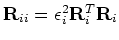 .
Throughout this paper, our discussion of the Hessian refers to its target-oriented approximation defined in equation A-5.
.
Throughout this paper, our discussion of the Hessian refers to its target-oriented approximation defined in equation A-5.
An inverted time-lapse image,
 , can be obtained as the difference between the two images,
 and
and
 :
:
|
|
|
|
| Target-oriented joint inversion of incomplete time-lapse seismic data sets | |
|



![\begin{displaymath}\begin{array}{cc} \left [ {\bf H}_{0}+{\bf R}_{00} \right ] \...
...11} \right ] \hat{{\bf m}}_{1}= \tilde {\bf m}_{1}, \end{array}\end{displaymath}](img37.png)
