


![[pdf]](icons/pdf.png)
|
|
|
|
| Angle-domain common-image gathers in generalized coordinates | |
|
 and
and
 in generalized coordinate systems to derive equation 10. I first assume that generalized coordinate systems are related to the Cartesian variables through a bijection (i.e., one-to-one mapping)
 . The bijection between a generalized and Cartesian coordinate system allows us to rewrite the left-hand-sides of equations 7 as (, )
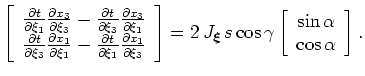 and
and

A similar argument can be used to construct the equations for the subsurface-offset axis. The bijection between the generalized coordinate and Cartesian subsurface-offset axes allows for the left-hand-side of equations 7 to be rewritten as
 |
(31) |
 is the subsurface-offset Jacobian of transformation. Expanding the Jacobian notation leads to
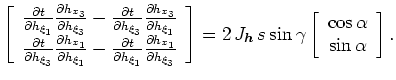 and
and

One question arising from the geometric factors in equation A-10 is what do the terms
,
,
 and
and
 represent? I assume that the subsurface offset axes are generated by uniform wavefield shifting such that the following equations are valid:
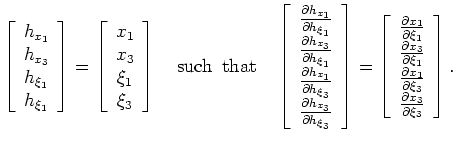 ), then the assumptions behind equations A-11 would not be honored.
Using these identities in equation A-5 reduces equation A-10 to
 ).
This completes the derivation of equation 10.
).
This completes the derivation of equation 10.
|
|
|
|
| Angle-domain common-image gathers in generalized coordinates | |
|


![$\displaystyle \left[ \begin{array}{c}
\frac{\partial t}{\partial \xi_1}\frac{\p...
...egin{array}{c}
{\rm sin} \alpha \\
{\rm cos} \alpha
\end{array} \right].$](img100.png)
![$\displaystyle \left[ \begin{array}{c}
\frac{\partial
x_1}{\partial \xi_3}
\left...
... \\
\frac{\partial x_3}{\partial \xi_3} {\rm cos} \alpha
\end{array} \right]$](img103.png)

![$\displaystyle \left[ \begin{array}{c}
\frac{\partial t}{\partial h_{\xi_1}}\fra...
...egin{array}{c}
{\rm cos} \alpha \\
{\rm sin} \alpha
\end{array} \right].$](img107.png)
![$\displaystyle \left[ \begin{array}{c}
\frac{\partial h_{x_1}}{\partial h_{\xi_1...
...{\partial h_{x_3}}{\partial h_{\xi_1}}
{\rm sin} \alpha
\end{array} \right],$](img110.png)


![$\displaystyle \left[\begin{array}{c}
h_{x_1} \\
h_{x_3} \\
h_{\xi_1}\\
h_{\x...
...x_1}{\partial \xi_3}\\
\frac{\partial x_3}{\partial \xi_3}
\end{array}\right].$](img115.png)
