


![[pdf]](icons/pdf.png)
|
|
|
|
| 3D shot-profile migration in ellipsoidal coordinates | |
|
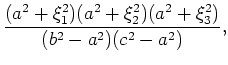
![$ \boldsymbol{\xi}=[\xi_1,\xi_2,\xi_3]$](img7.png) relative to a Cartesian mesh
given by
relative to a Cartesian mesh
given by
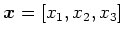
![$ \boldsymbol{x}=[x_1,x_2,x_3]$](img8.png) is (, ):
is (, ):
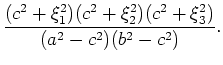 and
and  are constants defining the coordinate
system ellipticity and are constrained by three inequalities:
are constants defining the coordinate
system ellipticity and are constrained by three inequalities:
 ,
,
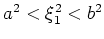 , and
, and
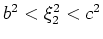 . Surfaces of constant
 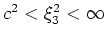 are confocal ellipsoids
and represent the direction of wavefield extrapolation, while those
of constant
are confocal ellipsoids
and represent the direction of wavefield extrapolation, while those
of constant  and
and  form two- and one-sheeted
hyperboloids, respectively. We note that because
equations 1 are defined by the squares of the variables,
each Cartesian point
form two- and one-sheeted
hyperboloids, respectively. We note that because
equations 1 are defined by the squares of the variables,
each Cartesian point
 is represented by eight
ellipsoidal points
is represented by eight
ellipsoidal points
 , one located in each octant.
Figures 1 and 2 present two
ellipsoidal coordinate examples. In each figure, we
infilled the four octants with positive arguments to form a
coordinate system appropriate for performing 3D wavefield
extrapolation. The difference between the two coordinate systems is
controlled by parameter  , where decreasing leads to a more
spherical mesh. Note that in this coordinate system waves can
propagate in all azimuthal directions, and usually at low angles to the
extrapolation direction in typical Gulf of Mexico velocity profiles.
, where decreasing leads to a more
spherical mesh. Note that in this coordinate system waves can
propagate in all azimuthal directions, and usually at low angles to the
extrapolation direction in typical Gulf of Mexico velocity profiles.
|
NarrowAzimuth
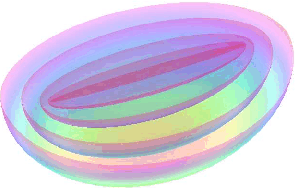
Figure 1. Example of an ellipsoidal coordinate system conforming to narrow-azimuth acquisition geometry created with the parameters ![$ [a,b,c]=[0,0.995,1]$](img1.png) . The figure shows
five confocal shells. [NR] . The figure shows
five confocal shells. [NR]
|
|
|---|---|
|
|
|
WideAzimuth
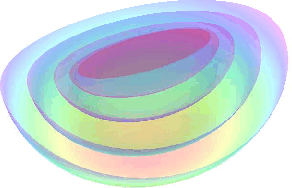
Figure 2. Example of an ellipsoidal coordinate system conforming to wide-azimuth acquisition geometry created with the parameters ![$ [a,b,c]=[0,0.925,1]$](img2.png) . The figure shows five
confocal shells.[NR] . The figure shows five
confocal shells.[NR]
|
|
|---|---|
|
|
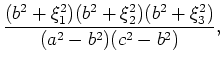
() define the elliptic-coordinate Helmholtz equation as
 is a wavefield,
  is the Laplacian operator,
 is angular frequency,
  is slowness (reciprocal of
velocity), and
is slowness (reciprocal of
velocity), and  is a general parameter defined by
 |
(A-3) |
 . This leads to a dispersion relationship of the
type studied in (),
. This leads to a dispersion relationship of the
type studied in (),
 are geometric coefficients,
 and
and
 is the wavenumber in the corresponding
  axis.
axis.
Overall, the ellipsoidal coordinate system as defined in
equation 1 is well suited to 3D shot-profile migration
in a geometric sense; however, two issues make it difficult to
implement accurately. First, the dispersion relationship in
equation 4 does not easily lend itself to implicit
finite-difference methods because of the imaginary first-order terms
(e.g.,
 ). Second, the octant-based definition
introduces non-uniqueness to the coordinate system variables.
Overall, making an ellipsoidal coordinate system practical for
wavefield extrapolation will require an alternate definition that
overcomes these two issues.
). Second, the octant-based definition
introduces non-uniqueness to the coordinate system variables.
Overall, making an ellipsoidal coordinate system practical for
wavefield extrapolation will require an alternate definition that
overcomes these two issues.
|
|
|
|
| 3D shot-profile migration in ellipsoidal coordinates | |
|



![$\displaystyle \nabla^2 U =
(\xi_3^2-\xi_2^2) S(\xi_1) \frac{\partial}{\partial \xi_1} \left[
S(\xi_1) \frac{\partial}{\partial \xi_1} \right]U +$](img25.png)
![$\displaystyle (\xi_1^2-\xi_3^2) S(\xi_2) \frac{\partial}{\partial \xi_2} \left[
S(\xi_2) \frac{\partial}{\partial \xi_2} \right] U +$](img26.png)
![$\displaystyle (\xi_1^2-\xi_2^2) S(\xi_3) \frac{\partial}{\partial \xi_3} \left[
S(\xi_3) \frac{\partial}{\partial \xi_3} \right] U = -\omega^2 s^2 U,$](img27.png)
