


![[pdf]](icons/pdf.png)
|
|
|
|
| Exact seismic velocities for TI media and extended Thomsen formulas for stronger anisotropies | |
|

More progress can be made by first noting that the quantity
![$\frac{1}{2}[1 + \chi(\theta)]$](img107.png) may
be written as a perfect square:
may
be written as a perfect square:
 . The denominator of the result is then proportional to
 , which is a useful form that I will keep.
The numerator however is now proportional to the square of
is therefore
, which is a useful form that I will keep.
The numerator however is now proportional to the square of
is therefore
 ,
do not depend directly on a weak anisotropy assumption, but only on the smallness
of
,
do not depend directly on a weak anisotropy assumption, but only on the smallness
of  compared to unity. However, the second ones, i.e., those removing the squares in the
formulas for the velocities, do depend directly on a type of weak anisotropy assumption --
similar in spirit to Thomsen's (1986) approximations.]
compared to unity. However, the second ones, i.e., those removing the squares in the
formulas for the velocities, do depend directly on a type of weak anisotropy assumption --
similar in spirit to Thomsen's (1986) approximations.]
Combining equation 22 with definition 12, it can also be shown that
Then, making use of the identity
 ,
the speed of the quasi-SV-wave is given by
,
the speed of the quasi-SV-wave is given by
A tedious but straightforward calculation based on equations 2, 11, and 23 shows that
the extreme value of
 -- although not exactly at
 -- nevertheless
occurs very close to this angle. This calculation is however more technical than others
presented here, so it will not be shown explicitly, but the results are confirmed
later in the graphical examples. A similar result (but not identical) holds for the
extended Thomsen formulas that follow.
-- nevertheless
occurs very close to this angle. This calculation is however more technical than others
presented here, so it will not be shown explicitly, but the results are confirmed
later in the graphical examples. A similar result (but not identical) holds for the
extended Thomsen formulas that follow.
|
|
|
|
| Exact seismic velocities for TI media and extended Thomsen formulas for stronger anisotropies | |
|
![\begin{displaymath}
\frac{1}{2}[1 + \chi(\theta)] = \frac{1}{4}\left(\frac{\tan\...
...\tan^2\theta+\tan^2\theta_m)^2}{4\tan^2\theta\tan^2\theta_m}.
\end{displaymath}](img108.png)
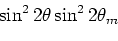
![\begin{displaymath}
\zeta(\theta) =
\frac{\zeta_m\sin^22\theta_m\sin^22\theta}{\left[1-\cos2\theta_m\cos2\theta\right]^2}.
\end{displaymath}](img112.png)
![\begin{eqnarray*}[(c_{11}-c_{44})\sin^2\theta + (c_{33}-c_{44})\cos^2\theta]^2 &...
...{\left[1 - \cos2\theta_m\cos2\theta\right]^2}{4\cos^4\theta_m}.
\end{eqnarray*}](img114.png)
![\begin{displaymath}
\sin^2\theta + \tan^2\theta_m\cos^2\theta =
\frac{\left[1 - \cos2\theta_m\cos2\theta\right]}{2\cos^2\theta_m},
\end{displaymath}](img115.png)
![\begin{displaymath}
\rho v^2_{sv}(\theta) \simeq c_{44} + (c_{11}-c_{44})\zeta_m...
...a_m\sin^2\theta\cos^2\theta}{[1 - \cos2\theta_m\cos2\theta]}.
\end{displaymath}](img117.png)
![\begin{displaymath}
\rho v_{p}^2 \simeq c_{33} + (c_{11}-c_{33})\sin^2\theta
- (...
...a_m\sin^2\theta\cos^2\theta}{[1 - \cos2\theta_m\cos2\theta]}.
\end{displaymath}](img118.png)