


![[pdf]](icons/pdf.png)
|
|
|
|
| Exact seismic velocities for TI media and extended Thomsen formulas for stronger anisotropies | |
|
Probably the easiest way to obtain formulas pertinent to HTI (horizontal transverse isotropy)
from VTI (vertical transverse isotropy) is to leave the stiffness matrix  alone, and
simply reinterpret the meaning of the Cartesian indices
alone, and
simply reinterpret the meaning of the Cartesian indices  . For VTI media, one typical choice
is
. For VTI media, one typical choice
is  , where
  is the vertical direction at the surface of the earth, or
more often the direction down into the earth. Then, the angle of incidence
is the vertical direction at the surface of the earth, or
more often the direction down into the earth. Then, the angle of incidence  is
measured with respect to , where
is
measured with respect to , where  means parallel to and
pointing into the earth, and
means parallel to and
pointing into the earth, and
 means horizontal incidence.
Considering aligned vertical fractures, with their axes of symmetry in the direction
 , the matrix itself presented in the main text need not change,
but the meaning of the angles does change. Clearly, the simplest case to study -- and the
only one analyzed here -- is the case of waves propagating at some angle to vertical
but always having a component in the direction
, the matrix itself presented in the main text need not change,
but the meaning of the angles does change. Clearly, the simplest case to study -- and the
only one analyzed here -- is the case of waves propagating at some angle to vertical
but always having a component in the direction  , while also having
  ,
thus lying in the
,
thus lying in the  -plane perpendicular to the fracture plane. (This case is special, but all
other wave speeds at other angles of propagation are easily found as a linear combination --
depending specifically on the azimuthal angle
-plane perpendicular to the fracture plane. (This case is special, but all
other wave speeds at other angles of propagation are easily found as a linear combination --
depending specifically on the azimuthal angle 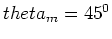 at the earth surface -- of
these values and those in the plane of the fractures themselves.) Then,
at the earth surface -- of
these values and those in the plane of the fractures themselves.) Then,
 corresponds exactly to the appearing in all the formulas up to
equation 39 in the main text, and
corresponds exactly to the appearing in all the formulas up to
equation 39 in the main text, and 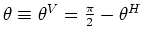 is the effective angle in the
-plane of incidence under consideration, i.e., the one perpendicular to the
vertical fractures in the reservoir. To obtain wave speeds at the angle ,
just substitute
is the effective angle in the
-plane of incidence under consideration, i.e., the one perpendicular to the
vertical fractures in the reservoir. To obtain wave speeds at the angle ,
just substitute
 , or write the speeds as
 and
and
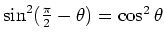 , and since
 and vice versa,
the entire procedure amounts to switching the locations of and
with
and vice versa,
the entire procedure amounts to switching the locations of and
with
 and
and
 everywhere in the exact expressions.
This procedure is obviously very straightforward to implement. The final results
analogous to Thomsen's formulas are:
 velocities are:
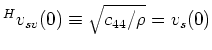 ,
,
 , and
, and
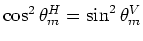 .
Also, recall that
.
Also, recall that
 .
.
For azimuthal angles
 , the algorithm for
computing the wave speeds is to replace
, the algorithm for
computing the wave speeds is to replace
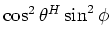 by
by
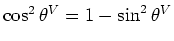 and
and
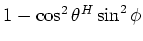 by
by
 in the exact
formulas, and corresponding replacements in the approximate ones.
Then, there is no angular dependence when
in the exact
formulas, and corresponding replacements in the approximate ones.
Then, there is no angular dependence when  or
or  as our point of view then lies
within the plane of the fracture itself. And, when
as our point of view then lies
within the plane of the fracture itself. And, when
 , the above stated
results for the -plane hold.
, the above stated
results for the -plane hold.
Wave equation reciprocity guarantees that the polarizations of the various waves are of the same types as our mental translation from VTI media to HTI media is made.
It is also worth pointing out that the labels  and
and  for the shear waves -- although analogous --
are, however, surely not strictly valid for the HTI case. For VTI media, the quasi--wave really
does have horizontal polarization at least at and
for the shear waves -- although analogous --
are, however, surely not strictly valid for the HTI case. For VTI media, the quasi--wave really
does have horizontal polarization at least at and  , whereas the
corresponding wave for HTI media, instead has polarization parallel (
, whereas the
corresponding wave for HTI media, instead has polarization parallel ( ) to the
fracture plane. For VTI media, the so-called quasi--wave has its polarization in the
plane of propagation, but this polarization direction is only truly vertical for
) to the
fracture plane. For VTI media, the so-called quasi--wave has its polarization in the
plane of propagation, but this polarization direction is only truly vertical for
 , at which point its polarization is both
vertical and perpendicular to the horizontal plane of symmetry. The corresponding situation
for HTI media has the wave corresponding to the -wave with polarization again in the plane
of propagation, but this is actually only vertical at
, at which point its polarization is both
vertical and perpendicular to the horizontal plane of symmetry. The corresponding situation
for HTI media has the wave corresponding to the -wave with polarization again in the plane
of propagation, but this is actually only vertical at
 , and also
parallel to the fracture plane; however, for all other angles its polarization has a
component that is perpendicular (
, and also
parallel to the fracture plane; however, for all other angles its polarization has a
component that is perpendicular ( ) to the plane of the fractures. So a much more
physically accurate naming convention for these waves would make use of the following designations:
) to the plane of the fractures. So a much more
physically accurate naming convention for these waves would make use of the following designations:
and notation for very
similar purposes.
|
|
|
|
| Exact seismic velocities for TI media and extended Thomsen formulas for stronger anisotropies | |
|




![\begin{displaymath}
^Hv_p(\theta^H)/^Hv_p(0) \simeq 1 - \frac{\epsilon}{1+2\epsi...
...2\theta^H\cos^2\theta^H}{[1 - \cos2\theta^H\cos2\theta_m^H]},
\end{displaymath}](img219.png)
![\begin{displaymath}
^Hv_{sv}(\theta^H)/^Hv_{sv}(0) \simeq 1 + \left[c_{33}/c_{44...
...2\theta^H\cos^2\theta^H}{[1 - \cos2\theta^H\cos2\theta_m^H]}.
\end{displaymath}](img220.png)


