Next: Diffracted multiple
Up: Kinematics of 2D multiples
Previous: Specular multiple from flat
I presented the particular case of flat water bottom case in some detail because
it lends itself to the nice closed-form equation for the residual moveout
of the multiples in ADCIGs. This equations is the basis for the design of the
Radon transform to attenuated the multiples. The
specular multiple from a dipping water-bottom has similar characteristics
although the moveout equations are more involved (, ) and will
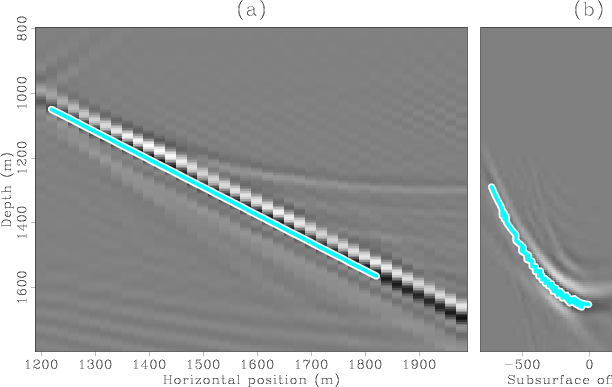
not be given here. Instead, I show in Figure 5 the zero
subsurface offset section, an SODCIG and its corresponding ADCIG. The lines
superimposed are the moveout curves computed with the equations in
(). The zero subsurface-offset section corresponds to a
reflector with twice the dip of the water-bottom. The ADCIG has its apex at
zero aperture angle.
|
|---|
wb-dip-moveout
Figure 5. Specular multiple from dipping water-bottom.
Panel (a) is the zero subsurface-offset section. Panel (b) is an ODCIG and
panel (c) is its corresponding ADCIG. The solid lines are the moveout curves
computed with the equations given by ().
|
|---|
![[pdf]](icons/pdf.png) ![[png]](icons/viewmag.png)
|
|---|
Next: Diffracted multiple
Up: Kinematics of 2D multiples
Previous: Specular multiple from flat
2007-10-24


