


 is equal to the dip
  measured at each point of the horizon.
 |
(1) |
![$\boldsymbol\nabla=[ \frac{\partial }{\partial x} \; \;
\frac{\partial }{\partial y} \; \; \frac{\partial }{\partial t} ]^T $](img6.gif) a
new system of equations can be built,
a
new system of equations can be built,
![\begin{displaymath}
{\bf
W}_\epsilon\boldsymbol{\nabla}= \left[ \begin{array}
{c...
...} \\ \frac{ \partial }{ \partial t} \end{array} \right] \quad ,\end{displaymath}](img7.gif) |
(2) |
 is the identity matrix and
  is a scaling parameter.
The residual is defined as
is a scaling parameter.
The residual is defined as
![\begin{displaymath}
\bf r \quad = \quad { {\bf
W}_\epsilon\boldsymbol{\nabla}
\b...
...c}{{\bf p}_x} \\ {{\bf p}_y} \\ {\bf 0} \end{array}\right] }.\end{displaymath}](img10.gif) |
(3) |
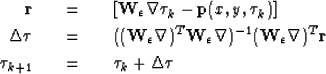
The dips need to be measured along the horizon, making the problem non-linear. A Gauss-Newton approach can be used with linearizing about the current estimated horizon volume. Again following the approach of (), we
iterate {
 |
(4) | |
| (5) | ||
| (6) |
} ,where the subscript k denotes the iteration number.
Two different approaches can be used for the linearized step (equation 5) The most efficient is to solve the problem a direct inverse in Fourier domain Lomask (2003). When space-domain weighting or model restriction () is needed, a space-domain conjugate gradient approach is warranted.
In general we deal with 2-D angle or offset gathers. The standard
approach is to solve a 2-D flattening problem where is a function of time/depth and offset. We revert to a 2-D gradient
operator, and solve each CMP/CRP gather independently.