


() discuss that Hale's DMO operator via a Fourier transform is computationally expensive because the DMO operator is temporally nonstationary. They use the technique of logarithmic time stretching, first introduced by () to present another derivation for the frequency-wavenumber log-stretch DMO operator.
() exploit the idea of computational efficiency of the logarithmic time stretching for the PS-DMO operator. I reformulate the work of () using the PS-DMO smile derived in the previous section and following a procedure similar to () and (). This operation is valid for a constant velocity case.
From equation 13, and following Hale's assumption that the DMO operator maps each sample of the NMO section (pn) from time tn to time t0 without changing its midpoint location, x [p0(t0,x,h) = pn(tn,x,h)], the 2-D PS-DMO operator in the f-k domain is
 |
(16) |
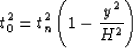
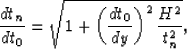
Equation (13) implies a change of variable from t0 to tn. From equation (13) we have
 |
(17) |
 |
(18) |
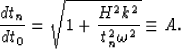
which I will represent as A or its Fourier equivalent:
 |
(19) |
 |
(20) |
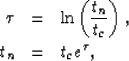
Equation (20) is the foundation of PS-DMO in the f-k domain. I introduce a time log-stretch transform pair,
 |
(21) | |
| (22) |
where tc is the minimum cutoff time introduced to avoid taking the logarithm of zero. The PS-DMO operator in the f-k log-stretch domain becomes
 |
(23) |
where
 |
(24) |
with
 |
(25) |
where  is the Fourier representation of the log-stretched time axis
  . The value
of the function
. The value
of the function  for either kh =0 or
  is obtained as zero by
taking the limit of the function for either
is obtained as zero by
taking the limit of the function for either  or
or  and applying the L'Hopital's rule.
The previous expression is equivalent to the one presented by (). Note that equation (25) is based on the assumption that p0(t0,x,h) = pn(tn,x,h). This does not include changes in midpoint position and/or common reflection point position. This leads to a correct kinematic operator but one with a poor amplitude distribution along steeply dipping reflectors.
() solve this problem for PP-DMO in the f-k log-stretch
domain by reformulating the f-k log-stretch PP-DMO operator
presented by (). This
operator is based on the
assumption that the midpoint changes its location after the
PP-DMO operator is applied [p0(t0,x0,h) = pn(tn,xn,h)], which leads
to a more accurate distribution of amplitudes.
Following the derivation used by () for PP-DMO, for steeply dipping
events I derive a more accurate
PS-DMO operator in the frequency-wavenumber log-stretch domain.
This new operator differs from the previous one in the function
of the filter  . The new expression is
![\begin{displaymath}
\Phi(\Omega,k,h) = \left \{ \begin{array}
{cc}
\alpha kh & ...
... ]} \right \} & \mbox{for $\Omega \ne 0$}
\end{array} \right .\end{displaymath}](img42.gif) |
(26) |
The values of the phase-like function at the points kh =0 and are obtained using L'Hopital's rule on the limit of the function , since
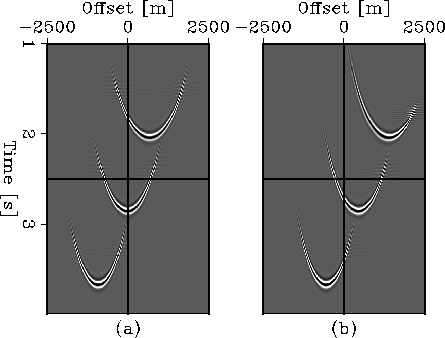
the function is singular at those points. Figure 6 shows a series of impulse responses for this
operator.
 |
![[*]](http://sepwww.stanford.edu/latex2html/movie.gif)


Note that for a value of  , equivalent to
  , the
filter reduces to the known expression for P-wave data ().
We can trust the PS results since
the PP impulse response, obtained with the filter in
equation 26 and , is
the same as that obtained by (). Moreover, the amplitude distribution follows
Jaramillo's result.
The 3-D representation for this PS-DMO operator is the
starting point for the partial-prestack migration operator presented in
Chapter 4.
, the
filter reduces to the known expression for P-wave data ().
We can trust the PS results since
the PP impulse response, obtained with the filter in
equation 26 and , is
the same as that obtained by (). Moreover, the amplitude distribution follows
Jaramillo's result.
The 3-D representation for this PS-DMO operator is the
starting point for the partial-prestack migration operator presented in
Chapter 4.