


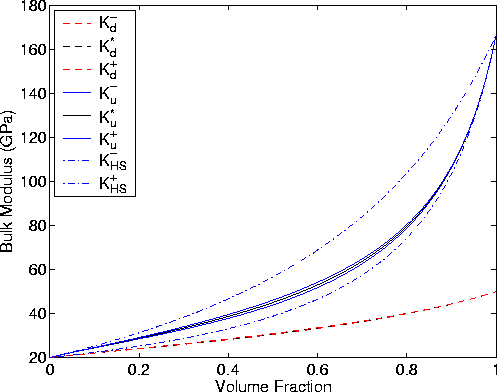
In Figure 9 as in Figure 6, the three drained curves for bulk modulus are so close together that they cannot be distinguished on the scale of this plot (although they can be distinguished if the plot is magnified). In contrast to Figure 6, the three undrained bulk modulus curves can now be distinguished, but they are still quite close together. The undrained curves start out at the same values as the drained curves because at zero volume fraction of constituent 2 the only fluid in the system is air. Then, as the volume fraction of constituent 2 increases, we add liquid up to the point where the final values at full liquid saturation are the same as in Figure 6. Again uncorrelated Hashin-Shtrikman bounds are shown for purposes of comparison, as in Figure 3. The Peselnick-Meister-Watt bounds on undrained bulk modulus -- making use of the laminated grain/crystal substructure and the polycrystalline nature of the overall reservoir model -- clearly are much tighter. Together Figures 3 and 9 also show that the polycrystalline-based bounding method produces a great improvement over the uncorrelated Hashin-Shtrikman bounds, whose microstructural information is limited to volume fraction data. This result is accomplished without having very detailed knowledge of the spatial correlations, just by using the fact that the local microstructure is layered. Knowledge of local layering is therefore a very important piece of microstructural information that has not been used to greatest advantage in prior applications of bounding methods for up-scaling purposes.
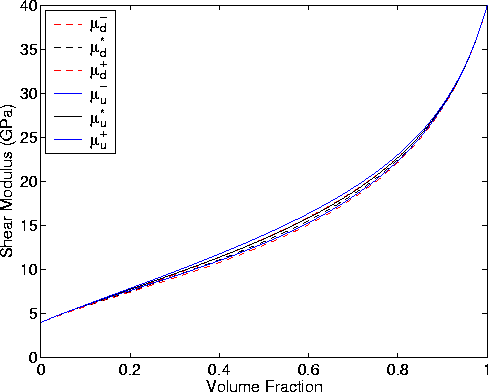
For Figure 10, the results are not so simple, as the six curves are all very close to each other. Undrained curves are always above the corresponding drained curves, but in general there is little separation to be seen here. Figure 11, like Figure 5, shows that the shear modulus changes with saturation are not really tightly coupled to the bulk modulus changes, and especially so at the lowest volume fractions of liquid, as the changes in shear compliance are again greater in magnitude there than the changes in the bulk compliance.
 |
 GPa and
(2) Kd(2) = 50.0 GPa,
GPa and
(2) Kd(2) = 50.0 GPa,  GPa. Skempton's
coefficient is taken to be B = 0.0 for constituent 1 (gas saturated),
and B = 1.0 for constituent 2 (liquid saturated). The
effective stress coefficients for the layers are, respectively,
GPa. Skempton's
coefficient is taken to be B = 0.0 for constituent 1 (gas saturated),
and B = 1.0 for constituent 2 (liquid saturated). The
effective stress coefficients for the layers are, respectively,
 and
and  . Porosity does not
play a direct role in the calculation when we are using B as the fluid
substitution parameter. Volume fraction of the layers varies from
0 to 100% of constituent number 2.
To emphasize the accuracy of the polycrystal bounds and
self-consistent estimates, uncorrelated Hashin-Shtrikman bounds
. Porosity does not
play a direct role in the calculation when we are using B as the fluid
substitution parameter. Volume fraction of the layers varies from
0 to 100% of constituent number 2.
To emphasize the accuracy of the polycrystal bounds and
self-consistent estimates, uncorrelated Hashin-Shtrikman bounds
 on undrained bulk modulus are also shown.

 |
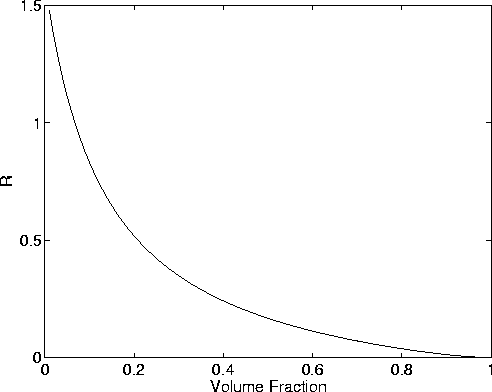 |
 . We find in contrast
that, for partial and patchy saturation, R can take any positive
value, or zero. Note that the magnitude of this effect is smaller
than in Figure 5, even though the degree of heterogeneity for bulk
modulus is greater here.
. We find in contrast
that, for partial and patchy saturation, R can take any positive
value, or zero. Note that the magnitude of this effect is smaller
than in Figure 5, even though the degree of heterogeneity for bulk
modulus is greater here.