


Next: Related topics
Up: Wang and Shan: Imaging
Previous: migration imaging and inversion
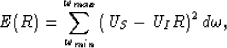
At the scattering point, we can define a "distance" or norm as
|  |
(39) |
where R is the reflectivity,  is the wavefield downward extrapolated to a reflector, and
  is the wavefield downward propagated to the reflector. The scattering wavefield should be equal to or close to the convolution result between the wavefield and the reflectivity.
Letting
is the wavefield downward propagated to the reflector. The scattering wavefield should be equal to or close to the convolution result between the wavefield and the reflectivity.
Letting
|  |
(40) |
we have
|  |
(41) |
If the incident wavefield equals zero, equation (![[*]](http://sepwww.stanford.edu/latex2html/cross_ref_motif.gif) ) is satisfied. However this case has no physical meaning. If the incident wavefield does not equal zero, then,
) is satisfied. However this case has no physical meaning. If the incident wavefield does not equal zero, then,
| 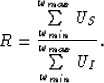 |
(42) |
In the complex domain, we can rewrite equation () as
| 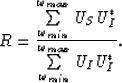 |
(43) |
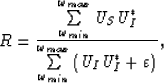
If the incident wave is quite weak, the following regularization should be introduced:
|  |
(44) |
where  is the regularization coefficient.
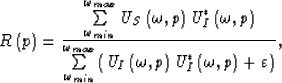
In fact, the reflectivity is related to the incident angle to a reflector of the plane-wave component of a seismic wave. Therefore, we should modify equation () into the following form to reach the angle gathers:
is the regularization coefficient.
In fact, the reflectivity is related to the incident angle to a reflector of the plane-wave component of a seismic wave. Therefore, we should modify equation () into the following form to reach the angle gathers:
|  |
(45) |
where  and
and  are a scattering plane wavefield and an incident plane wavefield, respectively.
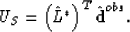
In fact, the extrapolated wavefield can be defined as
are a scattering plane wavefield and an incident plane wavefield, respectively.
In fact, the extrapolated wavefield can be defined as
|  |
(46) |
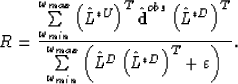
Therefore, in the frequency domain, equation () can be rewritten as
|  |
(47) |
We will further discuss this topic later to clarify the relationship.
Next: Related topics
Up: Wang and Shan: Imaging
Previous: migration imaging and inversion
Stanford Exploration Project
5/3/2005