


 are focused at a
single
are focused at a
single  for all x, and by design, have directly comparable amplitudes.
Conversely, corresponding crosstalk events on two model panels (e.g. residual
first-order multiples on
for all x, and by design, have directly comparable amplitudes.
Conversely, corresponding crosstalk events on two model panels (e.g. residual
first-order multiples on  and residual second-order multiples on
 ) generally have different residual moveout. While the exact
magnitude of the moveout differences depend on the choice of imaging operator,
Figure 1 illustrates that they generally are small at
near offsets, but more pronounced in the presence of subsurface complexity, and
at far offsets/reflection angles.
) generally have different residual moveout. While the exact
magnitude of the moveout differences depend on the choice of imaging operator,
Figure 1 illustrates that they generally are small at
near offsets, but more pronounced in the presence of subsurface complexity, and
at far offsets/reflection angles.
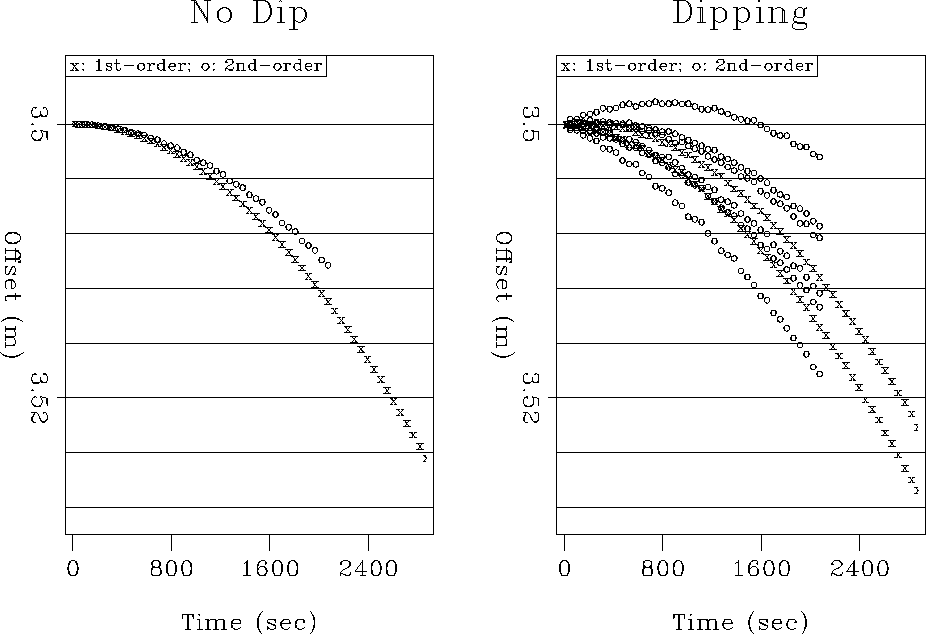 |
. ``o'' indicates position of the three second-order pegleg
events on both  and
and  . Left panel is with no
subsurface dip, right has seabed and target reflector dip of
. Left panel is with no
subsurface dip, right has seabed and target reflector dip of  . With
no dip, corresponding crosstalk events have little differential moveout. A
small amount of dip quickly increases differential moveout.
. With
no dip, corresponding crosstalk events have little differential moveout. A
small amount of dip quickly increases differential moveout.


We therefore conclude that at fixed  , the difference between two
 will be relatively small where there is signal, but large where
there is crosstalk noise. We now write this difference as a model residual:
will be relatively small where there is signal, but large where
there is crosstalk noise. We now write this difference as a model residual:
![\begin{displaymath}
\bold r_m^{[1]}[j](\tau,x) = \bold m_j(\tau,x) - \bold m_{j+...
...),
\hspace{0.1in} \mbox{where} \hspace{0.1in} j=[0,p(p+3)/2].\end{displaymath}](img31.gif) |
(7) |
 rather than
because the difference (7) is blind to the
order or leg of the pegleg corresponding to ; it is simply a straight
difference across all the model panels.
rather than
because the difference (7) is blind to the
order or leg of the pegleg corresponding to ; it is simply a straight
difference across all the model panels.
As mentioned early in this thesis, a central motivation for LSJIMP is the desire to combine information from the multiple and primary images by averaging. In addition to discriminating against crosstalk, equation (7) provides a systematic framework for this averaging. If a signal event on one image is obscured by noise, the noise may not be present on an adjacent image, and equation (7) will attenuate it. This regularization enforces a degree of smoothness and consistency between images.