


() of Delft University presented a very effective autoconvolutional modeling technique for surface-related multiples, known as the ``SRME'' (Surface-related Multiple Elimination) method. Assuming sufficiently dense source coverage, as is typical with 2-D towed-streamer marine data, the method accurately models all multiples which bounce downward at the acquisition datum, but nowhere else. SRME can model diffracted multiples and other complex events, and most compellingly, requires no prior knowledge of the subsurface geology. Once estimated, the SRME multiple model is usually subtracted from the recorded data by any number of adaptive subtraction techniques.
Postponing a discussion of SRME's limitations with 3-D narrow azimuth marine
data until Chapter ![[*]](http://sepwww.stanford.edu/latex2html/cross_ref_motif.gif) , the method has a number of
limitations in 2-D. The method obtains a multiple model by iteratively adding
terms of an infinite series, although in practice only one iteration is done.
After one iteration, the wavelet of the multiple model will generally be
stretched somewhat because it is generated via autoconvolution. Additionally,
the near-offset gap of the multiple model is twice that in the data. Since
near-offset multiple energy contributes most to the stack, accurate
extrapolation of the near-offset traces is crucial. Another limitation of SRME
is its tendency to ``over-predict'' higher-order multiples; this may hamper some
subtraction algorithms.
, the method has a number of
limitations in 2-D. The method obtains a multiple model by iteratively adding
terms of an infinite series, although in practice only one iteration is done.
After one iteration, the wavelet of the multiple model will generally be
stretched somewhat because it is generated via autoconvolution. Additionally,
the near-offset gap of the multiple model is twice that in the data. Since
near-offset multiple energy contributes most to the stack, accurate
extrapolation of the near-offset traces is crucial. Another limitation of SRME
is its tendency to ``over-predict'' higher-order multiples; this may hamper some
subtraction algorithms.
In this section, I compare an SRME multiple model (one iteration), computed by
Antoine Guitton, with a multiple model generated by the method outlined
previously for the computation of crosstalk (section ),
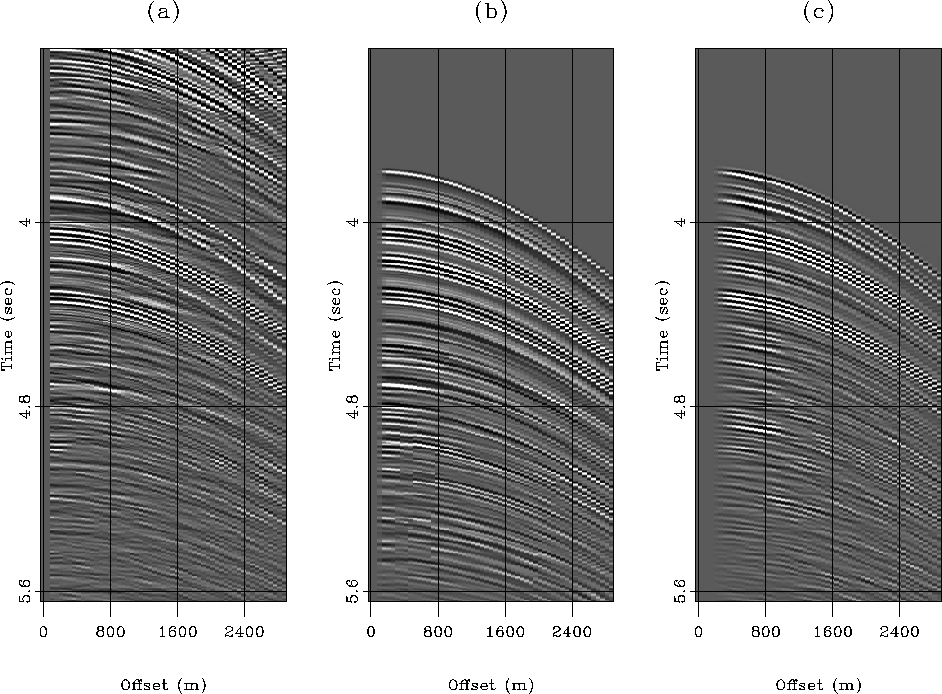
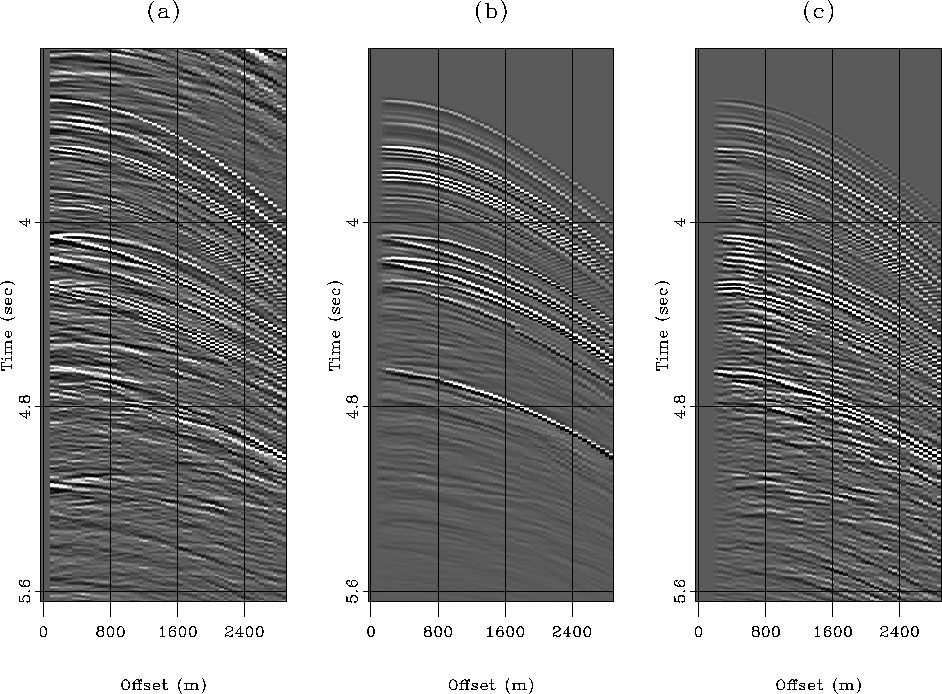
using HEMNO as the imaging engine. Figures 21 and
22 compare the SRME and HEMNO results at CMP locations 55
(1440 m) and 344 (9150 m), respectively. The results of LSJIMP at same CMP
locations are shown in Figures 9 and
10.
Figure 21 is taken from the sedimentary basin portion of the Mississippi Canyon data. We first notice the improved near-offset coverage of the HEMNO model. Kinematically, both HEMNO and SRME match the shallow multiple events quite accurately. Deeper in the gather, we see little order to the multiples in the data. Many of the primaries in the 2.5-3.5 second range may come from out-of-plane reflectors or diffractors, hence the multiples of these events will not have the expected kinematics. In 2-D, both HEMNO and SRME assume that all energy propagates in the plane of acquisition. Figure 22 is taken from over the salt body. Notice that both the HEMNO and SRME models fairly accurately represent the strong split peglegs from the top of salt reflection.
 |
 |
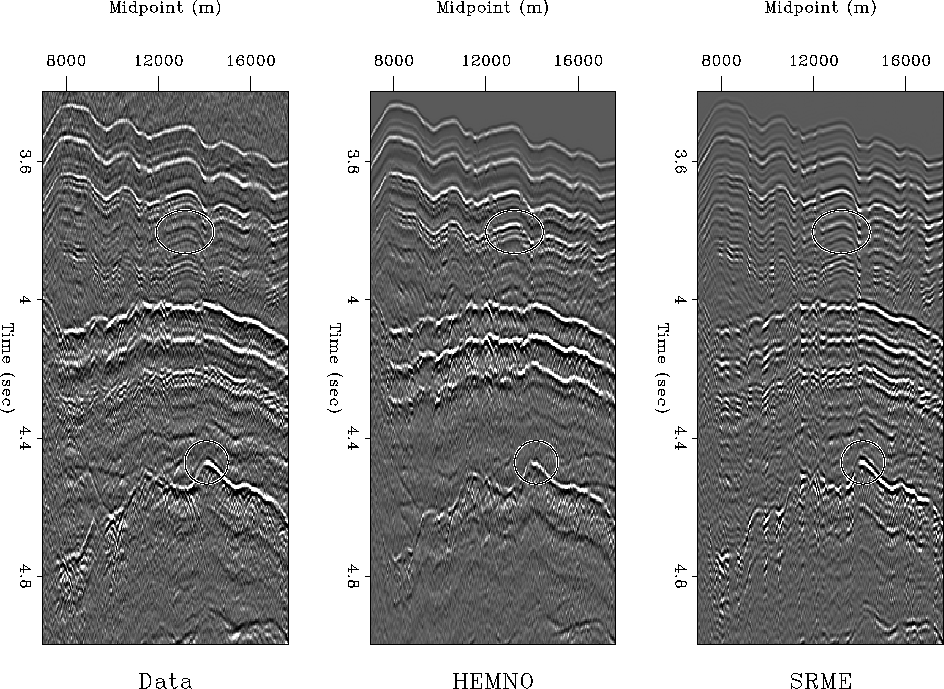
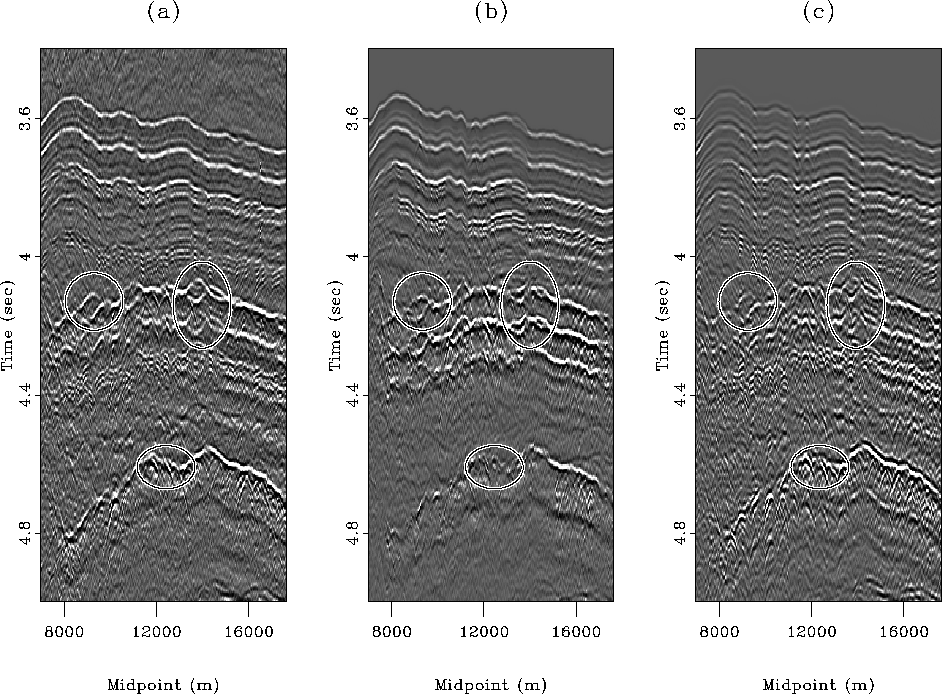
Figures 23 and 24 compare the HEMNO and SRME multiple models on constant-offset sections. Here, we can check each model for correct event positioning-especially important when complex peglegs split. On a near-offset section (Figure 23), we see that both methods accurately match the kinematics of the important multiple reflections. The region highlighted by the circle illustrates the stretched wavelet of the SRME model. The region highlighted by the oval shows how the poorly-estimated R1 reflection coefficient has caused an overly strong event to appear in the HEMNO model. On a medium-offset section (Figure 24) we again see that both models roughly mimic the multiples in the data. Of special interest is the positioning of split multiple events. In the region highlighted by the circle, all three methods correctly model the split pegleg. The amplitudes on the HEMNO model appear truer to the data. In the region highlighted by the tall oval, we see that the HEMNO model does not accurately represent the data, but the SRME model does. In the region highlighted by the wide oval, we see that SRME better models the diffractions and other features of the complex top of salt pure multiple.
 |
 |


