


WesternGeco supplied a depth interval velocity model with the data. I migrated the raw data and the LSJIMP primary data using a 2-D Extended Split-Step prestack depth migration algorithm () with three so-called ``reference velocities'' to handle lateral velocity variation. Image sampling in depth is 6.67 meters. The migration algorithm outputs gathers as a function of depth, midpoint, and subsurface offset. Using the method of (), the offset gathers are converted to Angle-domain Common-image gathers (ADCIGs) as a function of opening angle at the reflector.
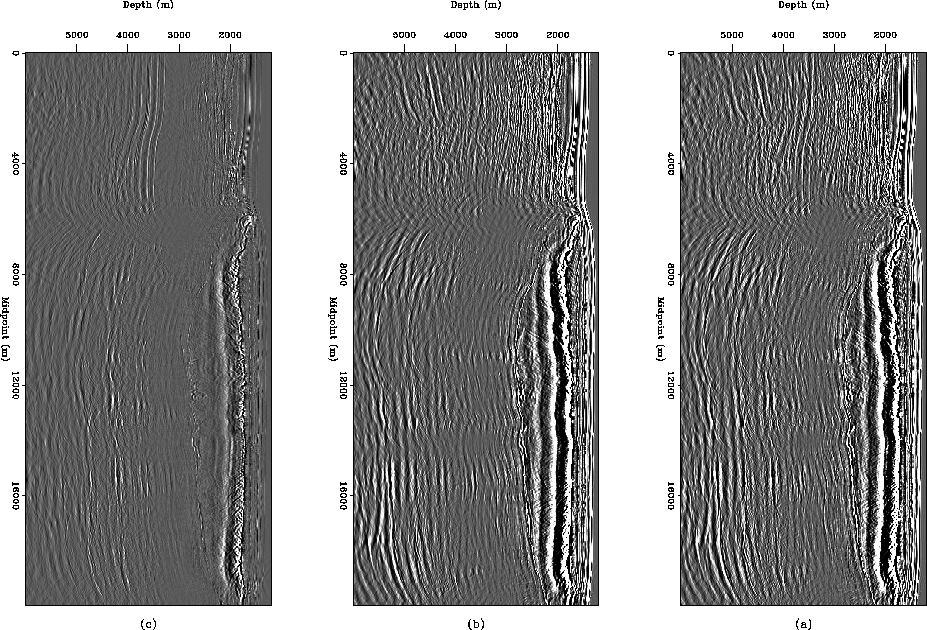
Figure 12 shows angle stacks, after a z1.5 gain, of the Mississippi Canyon raw data, the data after LSJIMP, and the difference of the two. The Figure is similar in style to Figure 6. The removed multiples are simplest to view on the left-hand side of the section, where the geology is less complicated than under the salt body. In the sedimentary region, we notice, as before, that LSJIMP can cleanly separate primaries from many different multiple reflections. In the salt region, the results are somewhat muddied, since migration strongly defocuses multiples. We see that much multiple energy has been removed, though much remains. Subsalt primaries, already difficult to spot without any multiple energy, are uncovered better, especially around 3500 meters depth. The dominant dip is negative (toward the surface with increasing midpoint).
For reasons explained in more detail in section ![[*]](http://sepwww.stanford.edu/latex2html/cross_ref_motif.gif) , some
primary energy is seen on the difference panel, where we hope to see only
multiple energy. The loss of primary energy, while well below the clip value
anywhere, is strongest for the top of salt reflection. Much of the lost energy
has a high spatial wavenumber, and likely arises from diffractions which my
implementation of LSJIMP cannot model. Also, the large velocity contrast at the
top of salt gives rise to strong head waves, which have a high apparent velocity.
These events, which are not flat after NMO for primaries, are filtered out as
noise by the LSJIMP regularization which differences across offset.
, some
primary energy is seen on the difference panel, where we hope to see only
multiple energy. The loss of primary energy, while well below the clip value
anywhere, is strongest for the top of salt reflection. Much of the lost energy
has a high spatial wavenumber, and likely arises from diffractions which my
implementation of LSJIMP cannot model. Also, the large velocity contrast at the
top of salt gives rise to strong head waves, which have a high apparent velocity.
These events, which are not flat after NMO for primaries, are filtered out as
noise by the LSJIMP regularization which differences across offset.
 |
Figures 13 and 14 illustrate, after z1.5 gain, ADCIGs at midpoints 55 and 344 (of 750), respectively. Compare these Figures to Figures 9 and 10. Figure 13 is extracted from the sedimentary region of the data. Notice that LSJIMP has quite cleanly separated multiples from the primaries, and certainly improved our ability to interpret the angle gather for amplitude-versus-angle phenomena.
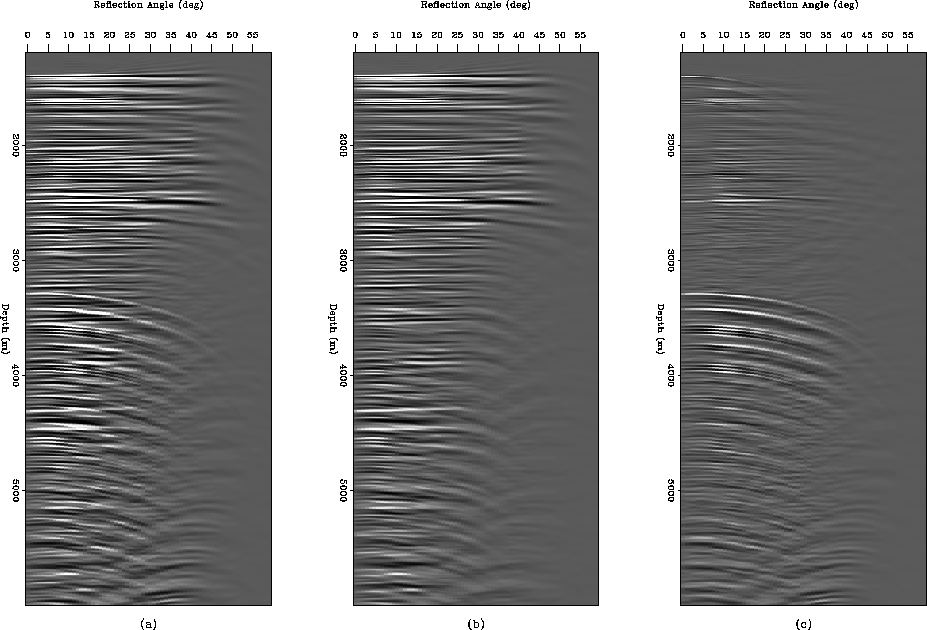 |
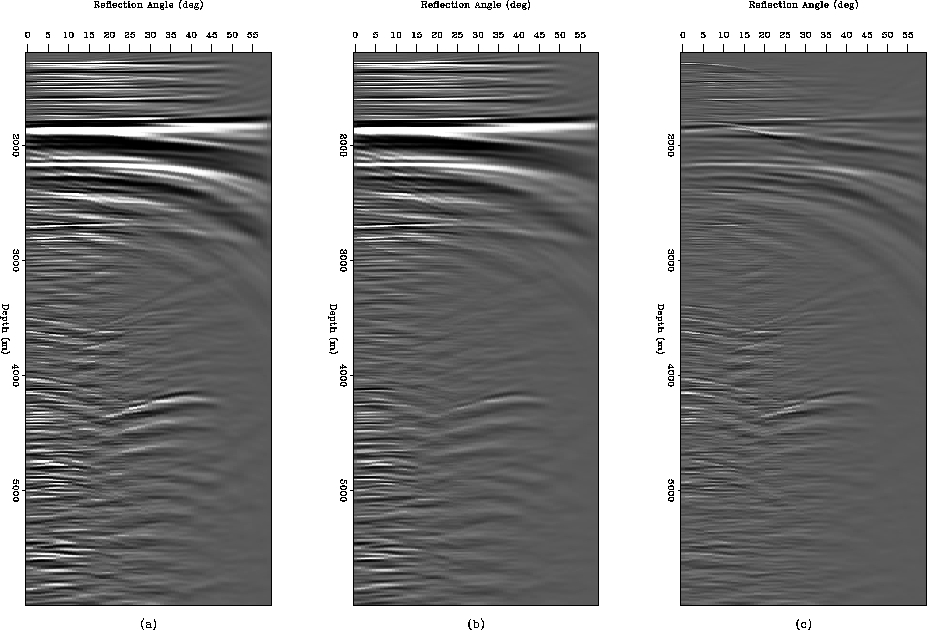
Figure 14, on the other hand, is extracted from the salt-bearing region of the data. Visually, it is far more difficult on the angle gather to distinguish primaries from multiples, although peglegs from shallow reflectors, between 3500 and 4300 meters depth, are recognizable and cleanly removed from the data, uncovering some hidden primaries. Notice that some downcurving reflections within the salt (1900 to 2800 meters depth), which may be internal multiples, are attenuated by LSJIMP, since they are not flat like true signal events. Furthermore, the events with negative dip below 4000 meters, which may be out-of-plane reflections or diffractions, are also attenuated somewhat.
 |
![[*]](http://sepwww.stanford.edu/latex2html/movie.gif)


