


In marine environments, three-dimensional reflection seismic data is normally
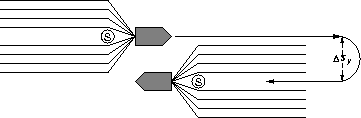
acquired in a so-called ``wide tow'' streamer configuration, illustrated in
Figure 1. Ironically, the crossline azimuth range of this
data is less than with most land acquisition geometries, so geophysicists often
call towed streamer data ``narrow azimuth'' data. Note that the crossline shot
interval,  , is chosen such that the outermost receiver line on one
swath overlaps the innermost receiver line on the previous swath. Figure
2 illustrates that such an acquisition geometry produces a
regularly sampled crossline CMP axis, if cable feathering is absent. In one
sense, this geometry boasts some degree of optimality, as it produces a
well-sampled 3-D image at a minimum cost.
, is chosen such that the outermost receiver line on one
swath overlaps the innermost receiver line on the previous swath. Figure
2 illustrates that such an acquisition geometry produces a
regularly sampled crossline CMP axis, if cable feathering is absent. In one
sense, this geometry boasts some degree of optimality, as it produces a
well-sampled 3-D image at a minimum cost.
 |

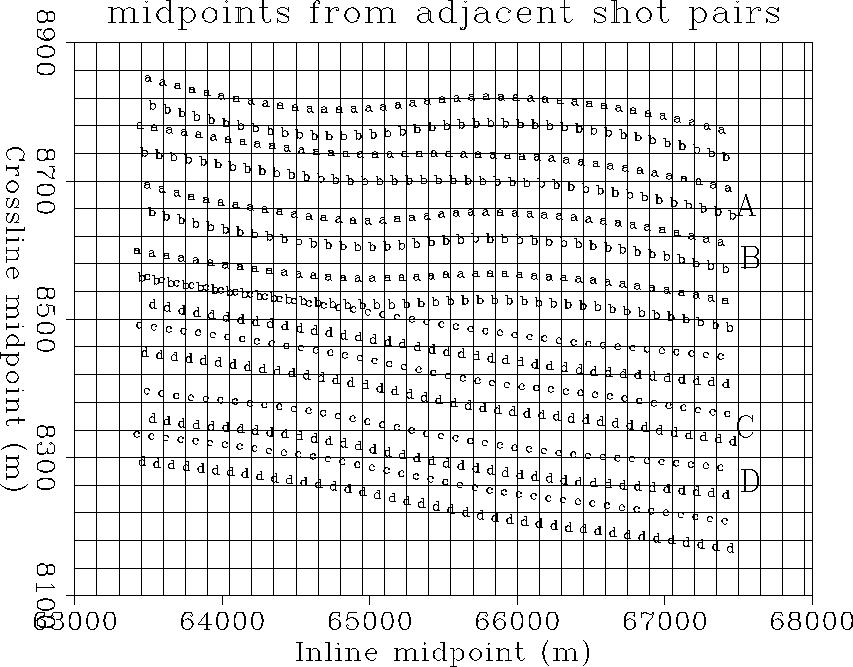 |
Unfortunately, geometry shown in Figure 2 causes the 3-D
extension of the SRME method of multiple prediction to fail spectacularly. SRME
requires to be relatively small-in practice, roughly the same as
commonly chosen crossline receiver line spacing parameters van Borstelen (2003).
3-D field datasets commonly have a crossline shot interval of up to ten times
the crossline receiver line spacing. Workarounds for the 3-D sampling problem
include: ignoring crossline structure and using a 2-D prediction, massive
(270,000 CPU hours) shot interpolation Kleemeyer et al. (2003), sparse inversion of the
crossline multiple contribution gathers Hokstad and Sollie (2003); van Dedem and Verschuur (2002),
and novel acquisition geometries Paffenholz (2003). Currently, none of these
methods combines proven accuracy with computational/cost efficiency.