


The vast size of the seismic imaging problems makes performing a direct inversion impossible with today's computer power, even if we are only dealing with a 2-D seismic line. Fortunately, we can closely approximate a direct inverse with iterative techniques. In particular, we can approximate a least-squares inversion with the conjugate-gradient minimization of this objective function:
 |
(1) |
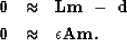
where boldL is a linear modeling operator, boldd is the data, and boldm is the model. This minimization can be expressed more concisely as a fitting goal:
 |
(2) |
 |
(3) | |
The first expression is the ``data fitting goal,'' meaning that it is
responsible for making a model that is consistent with the data. The
second expression is the ``model styling goal,'' meaning that it allows us
to impose some idea of what the model should look like using the
regularization operator  . The strength of the regularization
is controlled by the regularization parameter
. The strength of the regularization
is controlled by the regularization parameter  .
.
Unfortunately, the inversion process described by fitting goals (3)
can take many iterations to produce a satisfactory result.
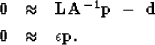
We can reduce the necessary number of iterations by making the problem
a preconditioned one. We use the preconditioning transformation
 Fomel et al. (1997); Fomel and Claerbout (2003) to give us these
fitting goals:
Fomel et al. (1997); Fomel and Claerbout (2003) to give us these
fitting goals:
 |
(4) | |
 is obtained by mapping the multi-dimensional regularization
operator to helical space and applying polynomial division
Claerbout (1998). This process is called Regularized Inversion with
model Preconditioning (RIP).
is obtained by mapping the multi-dimensional regularization
operator to helical space and applying polynomial division
Claerbout (1998). This process is called Regularized Inversion with
model Preconditioning (RIP).