


Now we have derived all the results needed to interpret Eq.
(28) and show how it is related to
(27). First, we note some of the main terms
missing from (28) are
those due to approximations made to  and the denominators
of (27), which have been approximated as
and the denominators
of (27), which have been approximated as
 instead of
  .Then, from (56), it is easy to see that
the final term in (28) vanishes to lowest
order, and that the remainder is given exactly by the shear modulus
fluctuation terms in brackets in (53) -- in complete agreement
with the final terms of (27). Then,
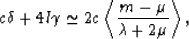
from (60), it follows that the leading
contribution to the factor
.Then, from (56), it is easy to see that
the final term in (28) vanishes to lowest
order, and that the remainder is given exactly by the shear modulus
fluctuation terms in brackets in (53) -- in complete agreement
with the final terms of (27). Then,
from (60), it follows that the leading
contribution to the factor  is
is
 |
(62) |
In the case of very strong fluctuations in the layer shear moduli,
then (53) and (60) both show that
pore fluids effects are magnified due to the fluctuations in layer
shear moduli and, therefore, contribute more to the anisotropy
correction factors  and
and  for undrained porous media. So these effects will be more easily
observed in seismic, sonic, or ultrasonic data under these
circumstances. When these effects are present,
the vertically polarized quasi-shear mode will show the highest
magnitude effect, the horizontally polarized shear mode will show
no effect, and the quasi-compressional mode will show an effect of
intermediate magnitude. It is known that these effects, when present,
are always strongest at
for undrained porous media. So these effects will be more easily
observed in seismic, sonic, or ultrasonic data under these
circumstances. When these effects are present,
the vertically polarized quasi-shear mode will show the highest
magnitude effect, the horizontally polarized shear mode will show
no effect, and the quasi-compressional mode will show an effect of
intermediate magnitude. It is known that these effects, when present,
are always strongest at  , and are diminished when the angle
of propagation is either
, and are diminished when the angle
of propagation is either  or
or  relative to the
layering direction. We will test these analytical predictions
with numerical examples in the next section.
relative to the
layering direction. We will test these analytical predictions
with numerical examples in the next section.
To summarize our main result here: The most significant contributions
of the liquid dependence to shear waves comes into the wave
dispersion formulas through coefficient a (or equivalently  ).
Equations (53) and (54) show that
).
Equations (53) and (54) show that
 , coefficients a and c have comparable
magnitude dependence on the fluid effects, but of opposite sign. For large
fluctuations, the effects on a are much larger (quadratic) than
those on c (linear). Propagation at normal incidence will
never show much effect due to the liquids, while propagation at angles
closer to can show large enhancements in both quasi-P and quasi-SV
waves (when shear fluctuations are large), but still no effect on SH waves.
, coefficients a and c have comparable
magnitude dependence on the fluid effects, but of opposite sign. For large
fluctuations, the effects on a are much larger (quadratic) than
those on c (linear). Propagation at normal incidence will
never show much effect due to the liquids, while propagation at angles
closer to can show large enhancements in both quasi-P and quasi-SV
waves (when shear fluctuations are large), but still no effect on SH waves.