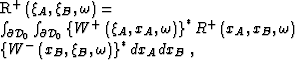
Above,  is the reflection response measured at point xA at the surface
(
is the reflection response measured at point xA at the surface
( ) in the presence of an impulsive source at
xB, while
) in the presence of an impulsive source at
xB, while  is the
transmission response measured at the surface point xA in the
presence of noise sources in the subsurface. Downward extrapolaton of
to
common surface locations
is the
transmission response measured at the surface point xA in the
presence of noise sources in the subsurface. Downward extrapolaton of
to
common surface locations  at an arbitrarily greater
depth is described by
at an arbitrarily greater
depth is described by
where  is the reflection response extrapolated from the surface to
some subsurface level and
is the reflection response extrapolated from the surface to
some subsurface level and  and
and  are forward-extrapolation
operators. If we substitute equation (
are forward-extrapolation
operators. If we substitute equation (![[*]](http://sepwww.stanford.edu/latex2html/cross_ref_motif.gif) ) into equation
() we obtain
) into equation
() we obtain
In the above relation, we used the fact that the reflection
coefficient of the free-surface is r=-1 and the reciprocity relation
of the forward-extrapolation operator  . Equation () shows that
by inverse-extrapolating the transmission response
. Equation () shows that
by inverse-extrapolating the transmission response
 at all
 at the surface to a certain subsurface level, and
forward-extrapolating the downward-reflected transmission response
at the surface to a certain subsurface level, and
forward-extrapolating the downward-reflected transmission response
 at all
 to the same subsurface level, followed by
cross-correlation of the resultant wave fields, we obtain the downward
extrapolated reflection response. If we subsequently apply the
imaging condition, we can image the subsurface at that level
Armtan et al. (2004)). If we compare this process
with shot-profile migration Claerbout (1971) we can see that they
are identical. This means that based on shot-profile migration we can
directly migrate passive white-noise data without the need to first
simulate the reflection shot gathers.
to the same subsurface level, followed by
cross-correlation of the resultant wave fields, we obtain the downward
extrapolated reflection response. If we subsequently apply the
imaging condition, we can image the subsurface at that level
Armtan et al. (2004)). If we compare this process
with shot-profile migration Claerbout (1971) we can see that they
are identical. This means that based on shot-profile migration we can
directly migrate passive white-noise data without the need to first
simulate the reflection shot gathers.
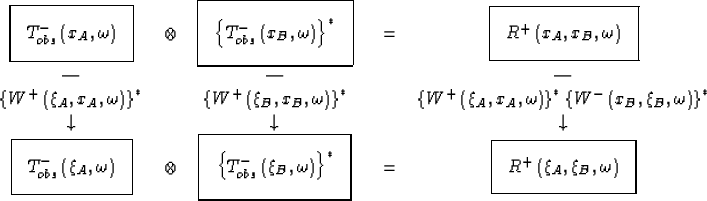
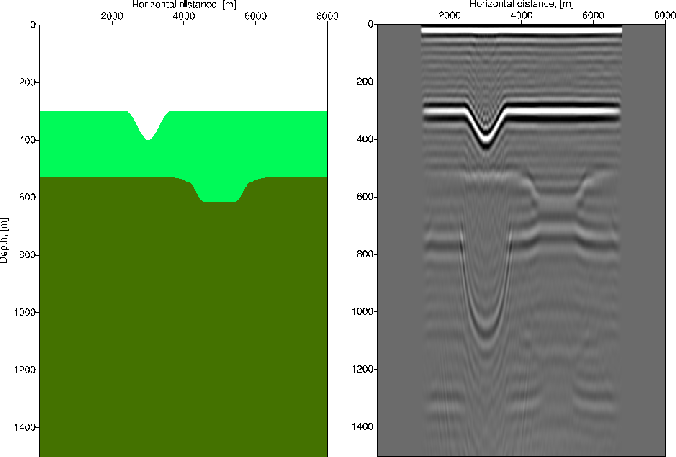
As Figure 1 shows, we may thus use two paths for obtaining a migrated image from passive data. Following the first path, we first cross-correlate the transmission responses recorded at the surface to simulate reflection shot gathers, then we extrapolate the simulated shot gathers and apply the imaging condition (this process was also proposed by Schuster 2001 and named Interferometric Imaging). The other way is to directly migrate the passive data - first we extrapolate the transmission responses recorded at the surface to some subsurface level, then we cross-correlate them and apply the imaging condition. The left panel of Figure 2 shows a double syncline model used to generate transmission responses of white-noise sources in the subsurface. These transmissions were afterwards migrated using both migration methods described above. The results were identical (Figure 2 ).
 |