


|
nybox
Figure 1 (a) The standard representation of the seismic acquisition grid. (b) Viable alternative to conventional orthogonal drawings. (c) Fourier transform of (a) with Nyquist sampling limits included. (d) Fourier transform of (b) with Nyquist sampling limits included. | 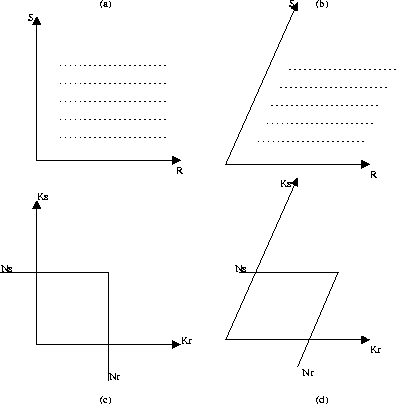 |

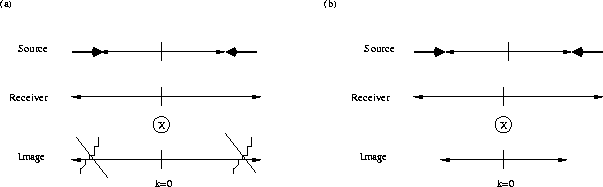
At the limit of this argument, we contend that it is much easier to de-couple completely the origins of these axis and plot them parallel to each other. Having performed a Fourier transform across space of both the source and receiver axes, we present them in Figure 2.
 |
Viewing these three distinct axes separately aids in the interpretation of this entire argument. Unfortunately, there is an historic tendency when analyzing the acquisition grid coordinates to include midpoint-offset, mh, axes as diagonal axes to those shown in Figure 1. We will avoid the use of midpoint while casting this presentation largely in the terms of shot-profile migration, as well as explain later the development of our x-axis during the imaging condition. Further, when they are superposed, an incorrect stretching is implied. We will briefly consider the mid-point axis, in order to highlight the danger of this practice.
The mapping transformation of energy from one coordinate frame to the other has been historically defined as:
 |
(1) | |
| (2) |
 |
(3) |
 . Drawing a midpoint axis
along the 45o line of the sr-axis is confusing when someone
attempts to find value of a particular midpoint location on the
plane. Some measurement of distance must be employed as a zero-offset
location does not lie on one of the original axes. The next problem
we then face is which of the multitude of distance measures we should
select: l?. The historic choice has been the square-root of the
sum of the squares: l2. If we make that choice, we then apply the
determinant presented above to cancel the
. Drawing a midpoint axis
along the 45o line of the sr-axis is confusing when someone
attempts to find value of a particular midpoint location on the
plane. Some measurement of distance must be employed as a zero-offset
location does not lie on one of the original axes. The next problem
we then face is which of the multitude of distance measures we should
select: l?. The historic choice has been the square-root of the
sum of the squares: l2. If we make that choice, we then apply the
determinant presented above to cancel the  factor associated
with the norm that so naturally lends itself to pieces of paper. We
could have chosen any norm. Each of them would return a different
number, and none of them have any more or less value for locating
a seismic image on the surface of the earth.
factor associated
with the norm that so naturally lends itself to pieces of paper. We
could have chosen any norm. Each of them would return a different
number, and none of them have any more or less value for locating
a seismic image on the surface of the earth.
The cross-correlation imaging condition with subsurface offset Rickett and Sava (2001)
 |
(4) |
The Appendix develops in rigorous detail the wavenumber limits acceptable in the image to eliminate completely alias contamination. The analysis of the problem centers around the effects of the migration process on the data grid, without needing to consider the values of the data on each grid node. We thus draw an analogy to the body of work available from crystallography, where structure can be analyzed mathematically without need to know what atom resides at any particular location. Thankfully, the regular Cartesian grid on which we normally acquire and process seismic data is a simple rectilinear crystal, though of several more dimensions than seen under a microscope.
The reference crystal we will consider will be the archetypal seismic
grid where sources and receivers occupy all locations and share the
same spacing increment. The suspicious or simply inquisitive reader
can now turn to the appendix to work through the details of the
following result. The maximum allowable wavenumbers,  , to
avoid artifacts due to migration operator aliasing is
, to
avoid artifacts due to migration operator aliasing is
 |
(5) |
 and
and  are the Nyquist frequencies defined by
fundamental sampling intervals
are the Nyquist frequencies defined by
fundamental sampling intervals  , a's are subsampling
factors, and
, a's are subsampling
factors, and  stands for least common factor (which will
change to
stands for least common factor (which will
change to  if the subsampling factors are integers. The
subscript
if the subsampling factors are integers. The
subscript  denotes the sampling associated with the model space
and is included to maintain parallelism with the appendix.
denotes the sampling associated with the model space
and is included to maintain parallelism with the appendix.
We consider three approaches to remove the aliasing problems associated with the acquisition and subsampling situations mentioned above during shot-profile migration. First, wavenumbers from the source and receiver wavefields at each depth level are band-limited to prevent the entry of aliased duplications into the image during the imaging condition. This does not require eliminating these components from the propagating wavefields, as we can save appropriate portions of the wavefields in temporary buffers for imaging condition evaluation. Second, a band-limited source function, with a wavenumber spectrum limited to the cutoff frequencies imposed by the resampled shot axis, is propagated throughout the migration process. This effectively zeros energy in the aliased band during the convolution in the imaging condition. No additional computational overhead is required for the latter alternative, though anti-aliasing by band-limited imaging requires two additional Fourier transforms for a split-step Fourier migration strategy. It should be noted, however, that both of these approaches will remove energy across both kx and kh axes.
A third alternative is to restrict the wavenumbers of the subsurface offset axis kh during imaging. Casting the imaging condition in terms of it Fourier dual can allow similar mitigation options. Because ks-kr=kh, we can select (ks,kr) combinations during the imaging condition that do not exceed our prescribed bandwidth. The multiplication of the source and receiver wavefields shown above takes the form of a convolution in the Fourier domain, which can be utilized to insert our anti-aliasing criteria. Lastly, decimating the receiver wavefield to match the shot increment, will be discussed in more detail with reference to shot-geophone style migration.