


Figure 5 shows a comparison of three snapshots in the (x,z) plane of the source wavefield computed for the three different surface boundary conditions in a VOZ medium. The extrapolation method used was phase-shift.
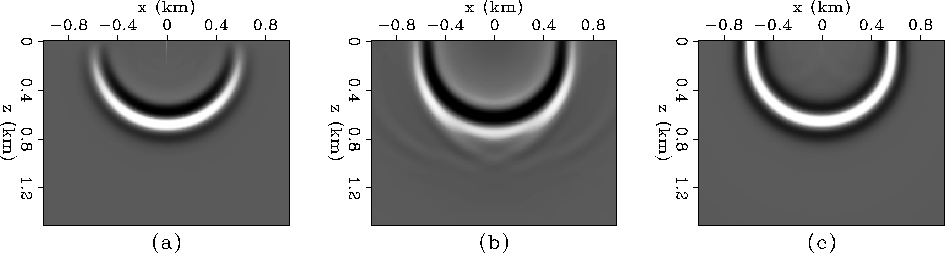 |

Figure 6 shows a comparison of the amplitudes along the wavefront depending on the propagation angle. We can see that for the
traditional surface boundary condition (dotted curve), the
amplitude along the wavefront fails to follow the theoretical trend Winbow (1995) (dot-dash curve)-it is high
for sub-vertical propagation, but it fades away at higher
angle and completely disappears for horizontal propagation. The curve corresponding to Zhang's surface boundary condition (dashed curve) and the curve corresponding to the proposed surface boundary condition (solid curve) match the theoretical curve up to  . After that angle, Zhang's surface boundary condition gives a lower value than the theoretical while the proposed surface boundary condition gives a higher value than the theoretical. Overall, the curve corresponding to the proposed surface boundary condition agrees better with the theoretical curve.
|
comp_max_voz_Dickens_bis
Figure 6 Amplitudes along the wavefields in a voz medium. | 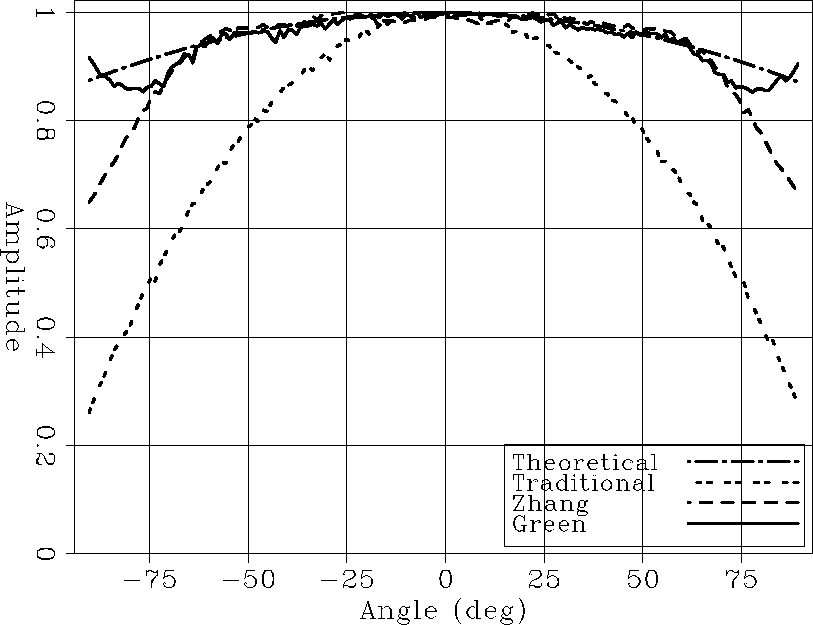 |