


Zhang (1993) proposes a different surface boundary condition, together with a correction for the source and receiver wavefields extrapolation, aiming to improve the dynamic information of the one-way wave equation. Zhang et al. (2001) apply this surface boundary condition to obtain a true-amplitude shot profile migration result in the WKBJ sense Shan and Biondi (2003). Zhang's surface boundary condition is stated as follows:
 |
(2) |
 |
(3) |
 is the new source wavefield that satisfies the corrected one-way wave equation Zhang et al. (2001),
  is the square-root operator, v is the medium velocity, kz is the vertical wavenumber, and
  is the horizontal wavenumber vector.
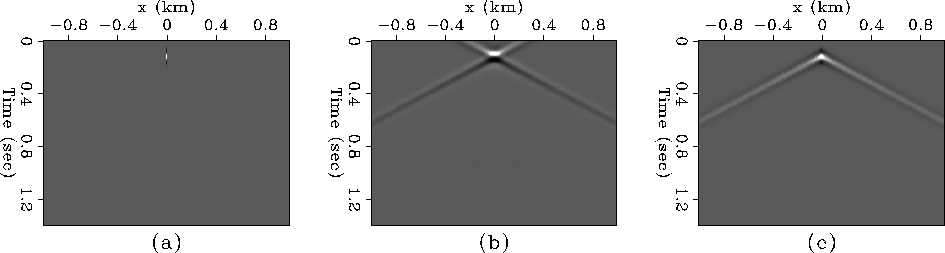
This boundary condition is not only an impulse at the shot position (Figure 1a) but also includes a contribution at different times and surface positions depending on the surface velocity (Figure 1b). This appears to resolve the contradiction discussed by Nichols (1994), by creating a V-shaped curve as the surface boundary condition. It mimics a wavefield with a high angle of propagation at the surface, resulting in more homogeneous wavefronts.
The implementation of Zhang's surface boundary condition has the disadvantage that the square root operator () is undefined for high values of the spatial wavenumber. That is why there is the need of establishing a cut off for the spatial wavenumber limiting the accuracy of the steep angles.
 |
