


Next: Depth Controlled Reflection tomography
Up: Chen et al.: Reflection
Previous: Introduction
For reflection data, there are two things that can cause traveltime perturbation: slowness perturbation  and reflector movement
  . Figure
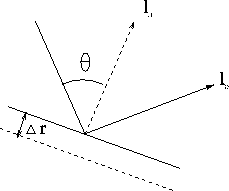
 ![[*]](http://sepwww.stanford.edu/latex2html/cross_ref_motif.gif) demonstrates the basic geometry for the reflection tomography problem. Here, ln is the normal ray, lo is the offset ray with aperture angle
demonstrates the basic geometry for the reflection tomography problem. Here, ln is the normal ray, lo is the offset ray with aperture angle  , and is the normal shift between exact reflector and apparent reflector.
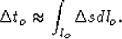
According to Fermat's principle, the traveltime perturbation caused by slowness perturbation,  , can be mapped approximately to slowness perturbation by the following linear relationship:
|  |
(1) |
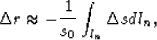
According to van Trier 1990, the reflector movement can be assumed equal to the residual zero-offset migration of the reflector. Consequently, can be mapped to the slowness perturbation along the normal (zero-offset) ray, which can be expressed by the following equation
|  |
(2) |
where s0 is the local slowness at the reflection point.
According to Fermat's principle, the reflector movement causes  change in ray length. As a result, the traveltime perturbation caused by reflector movement is
|  |
(3) |
ref
Figure 1 Geometry for reflection wave propagation. lo is the offset ray. ln is the normal ray. is the aperture angle of the offset ray. is the normal shift between apparent reflector and correct reflector.
|
|  |

By summing and  , we can obtain the total traveltime perturbation:
|  |
(4) |
Equation (4) provides a linear relationship between reflection traveltime perturbation  and slowness perturbation which can be used for backpropagation.
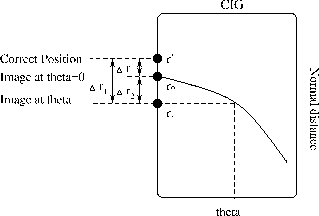
For migration velocity analysis, reflection traveltime perturbation, , can be effectively obtained from angle-domain common-image-gathers (ADCIG) Clapp (2001). Figure is a sketch of ADCIG. Here, is the normal shift between correct reflection position and apparent reflection position;  is the residual moveout; and
  is the total normal shift. According to Biondi and Symes 2003, the traveltime perturbation can be calculated from total normal shift by following equation:
|  |
(5) |
Combining equation (5) and (3), we can obtain reflection traveltime perturbation from residual moveout by following equation:
|  |
(6) |
As we can see, and can provide independent data information for velocity inversion. However, from reflection data, we can not obtain them separately since the reflection data alone can not provide the exact reflector position. Instead, we can only obtain which is the sum of and for reflection tomography.
expl_data_adcig
Figure 2 Illustration of calculating  for reflection tomography from angle-domain CIGs for reflection tomography from angle-domain CIGs
|
|  |
Next: Depth Controlled Reflection tomography
Up: Chen et al.: Reflection
Previous: Introduction
Stanford Exploration Project
10/14/2003