


 , where
  is aperture angle. From
this volume
we need to pick the best
is aperture angle. From
this volume
we need to pick the best  as a function of x and z.
I also have the problem that even with the redefinition of the
residual Stolt migration problem in Equation (
as a function of x and z.
I also have the problem that even with the redefinition of the
residual Stolt migration problem in Equation (![[*]](http://sepwww.stanford.edu/latex2html/cross_ref_motif.gif) ), events
still have some movement at different 's.
For now I will ignore the movement problem on the theory
that as long as we tend towards the correct solution, the best
focusing will tend towards 1 and the amount of
mispositioning at the best focusing will decrease.
), events
still have some movement at different 's.
For now I will ignore the movement problem on the theory
that as long as we tend towards the correct solution, the best
focusing will tend towards 1 and the amount of
mispositioning at the best focusing will decrease.
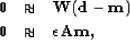
For now I took a rather simple approach. I calculated
the semblance for flat events at the different values.
I then picked the best ratio at
each location. I used this field as my data  . I used
the maximum semblance at each location as a weighting operator
. I used
the maximum semblance at each location as a weighting operator  to
give more preference to strong events. I used
a 2-D gradient operator for my regularization operator
to
give more preference to strong events. I used
a 2-D gradient operator for my regularization operator  and solved
the inversion problem defined by the fitting goals,
and solved
the inversion problem defined by the fitting goals,
 |
(8) | |
 is the amount of relative smoothing and
 is the resulting model.
A better method, and a topic for future work,
would be to calculate the semblance for a range of moveouts and do
a non-linear search for a smooth function.
is the resulting model.
A better method, and a topic for future work,
would be to calculate the semblance for a range of moveouts and do
a non-linear search for a smooth function.
To test whether the method works I scanned over values from
.95 to 1.05 on the migration result shown
in the center panel of Figure .
The left panel of Figure
shows the selected ratio, ,
in
fitting goals () and the right panel shows a histogram of
the picked values.
Note how we have generally picked the correct value ( ).
).
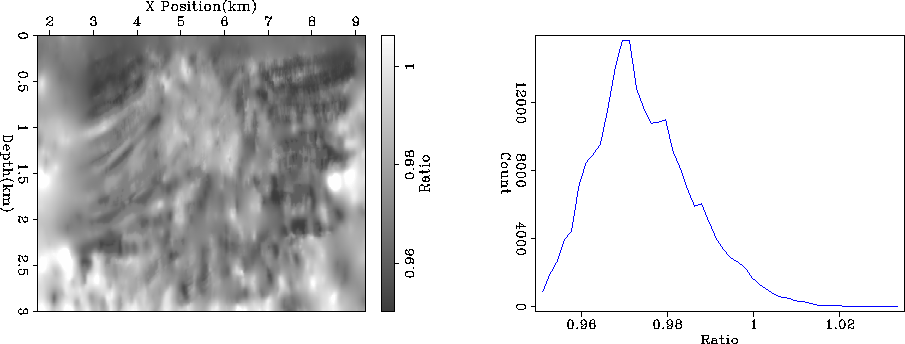 |
value using
fitting goals (). The right panel is a histogram of the picked
values. Note the peak at approximately .97, the inverse of the velocity scaling.
![[*]](http://sepwww.stanford.edu/latex2html/movie.gif)


