


![[*]](http://sepwww.stanford.edu/latex2html/cross_ref_motif.gif) )) and the preconditioned inversion
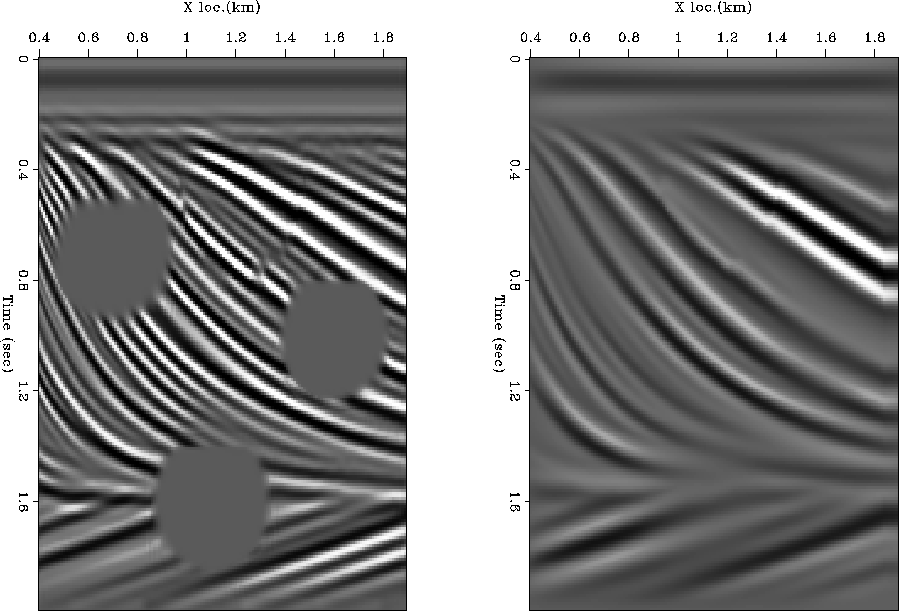
(fitting goals ()). I am concerned with the behavior in early
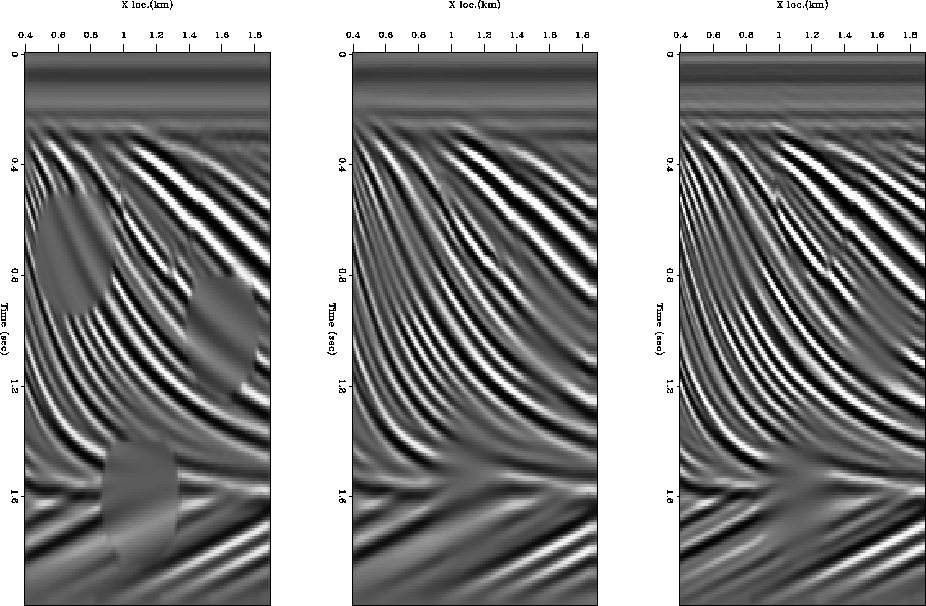
iterations, so I just ran 6 iterations of each. These results are in
Figure .
)) and the preconditioned inversion
(fitting goals ()). I am concerned with the behavior in early
iterations, so I just ran 6 iterations of each. These results are in
Figure .
 |
![[*]](http://sepwww.stanford.edu/latex2html/movie.gif)


The regularized result is high frequency, but it has barely begun to fill in the areas affected by the null space. This is exactly the behavior we expect at early iterations in a regularized inversion. The preconditioned result has completely filled in the areas affected by the null space, meaning that it has defined solutions at every point (although not the ideal solution), but it is very low frequency. Once again, this is expected and has been seen in earlier works with imaging operators (, , ).
The previous example helps to demonstrate two important points made by (). First, both regularized inversion and preconditioned inversion take a great many iterations to converge. While this is not a problem for a toy problem like the one presented in this paper, it is impossible for a real geophysical problem like imaging in complex areas. The operators used in such a problem are infinitely more complex than those used in this simple interpolation problem, so it is vital that we minimize the number of iterations needed (). Secondly, when we limit ourselves to a small number of iterations, we encounter several problems with both regularization and preconditioning. These problems include:
Clearly, in order to obtain a high frequency result with defined solutions at
every point in a small number of iterations, we need some combination of the
regularized and preconditioned
inversions. I chose to run a small number of preconditioned iterations then
use that result as an initial model for a small number of regularized iterations.
I chose to test two different combinations, one with 3 iterations of preconditioned
inversion and 3 iterations of regularized inversion and one with 5 iterations of
preconditioned inversion and 1 iteration of regularized inversion. These results
are in Figure .
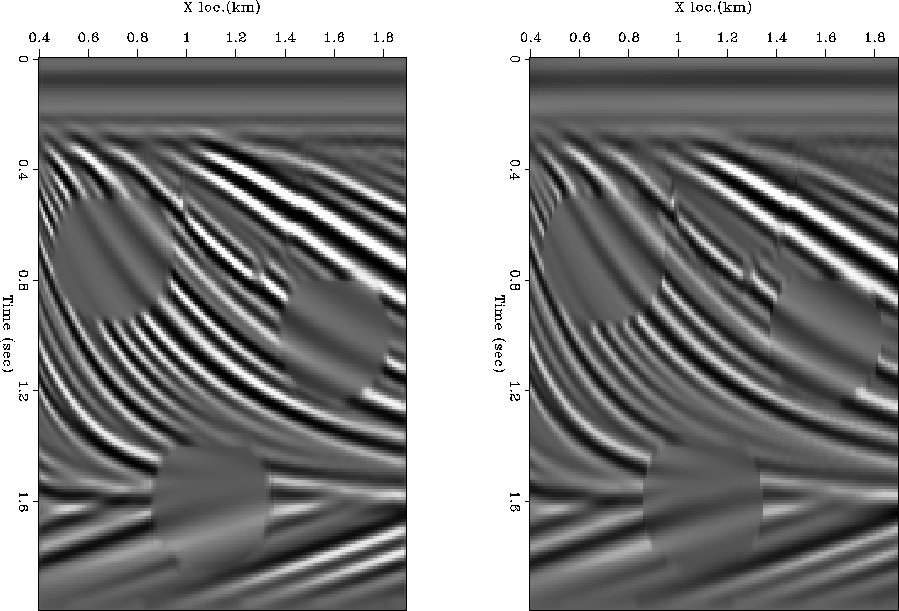 |
Both of the CIPR results contain higher frequencies than the
purely preconditioned result (right panel Figure ) and fill the
areas affected by the null space better than the purely regularized result
(left panel Figure ). Determining which CIPR result is ``better''
is fairly subjective, but I chose to compare them by looking at their frequency
spectrums. This can be seen in Figure . The frequencies
shown in this figure are the average over all of the traces.
|
spectrum
Figure 4 Comparison of the frequency content of the resulting models seen in Figures and
along with the frequency content of the correct
model (right panel of Figure ).
| 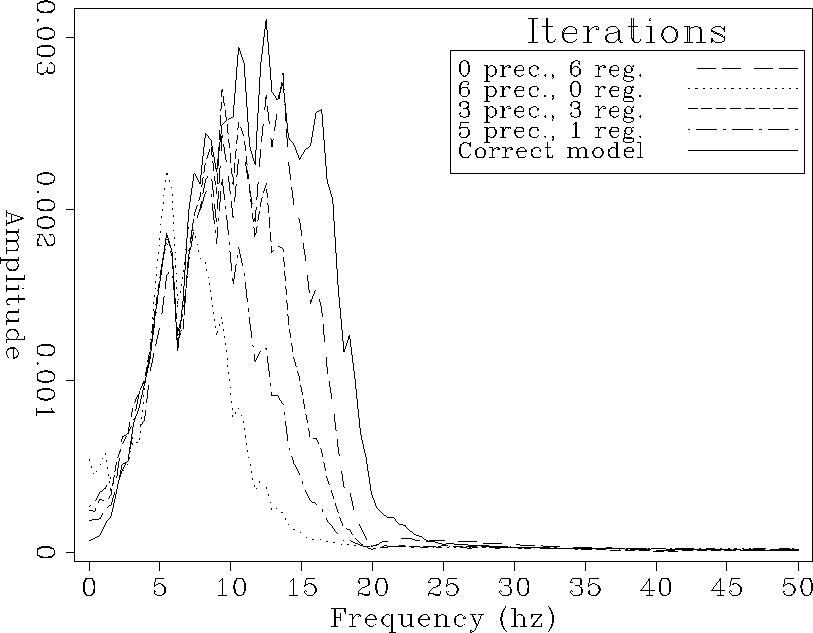 |
Figure shows the frequency spectra of the results in
Figure and Figure along with the
frequency spectrum of the ``ideal'' model in Figure .
As expected, the frequency content of the regularized inversion is close to
that of the ideal model and the frequency content of the preconditioned
inversion is much lower than the ideal model. It is more interesting to
compare the frequency contents of the two different CIPR results.
This shows us that the inversion using 3 iterations of preconditioning with
3 iterations of regularization has a frequency content closer to the ideal
model than that of the inversion using 5 preconditioned iterations and 1
regularized iteration. This is particularly interesting because it indicates
that both preconditioning and regularization are important to get the most
improvement.
In this paper, I will consider the CIPR result using 3 iterations of
preconditioned inversion and 3 iterations of regularized inversion to be my
``best'' result. Given this result, I felt it would be instructional to
see how many iterations of just preconditioned inversion
(fitting goals ()) it would take to get an equivalent frequency
content. It took 30 iterations of preconditioned inversion to get the same
frequency content as the ``best'' result. The frequency content of the result
can be seen in Figure . One again, the frequencies shown here
are the average over all of the traces.
|
speccomp
Figure 5 Comparison of the frequency content of the results of 3 iterations of preconditioned inversion with 3 iterations of regularized inversion and 30 iterations of just preconditioned inversion. | 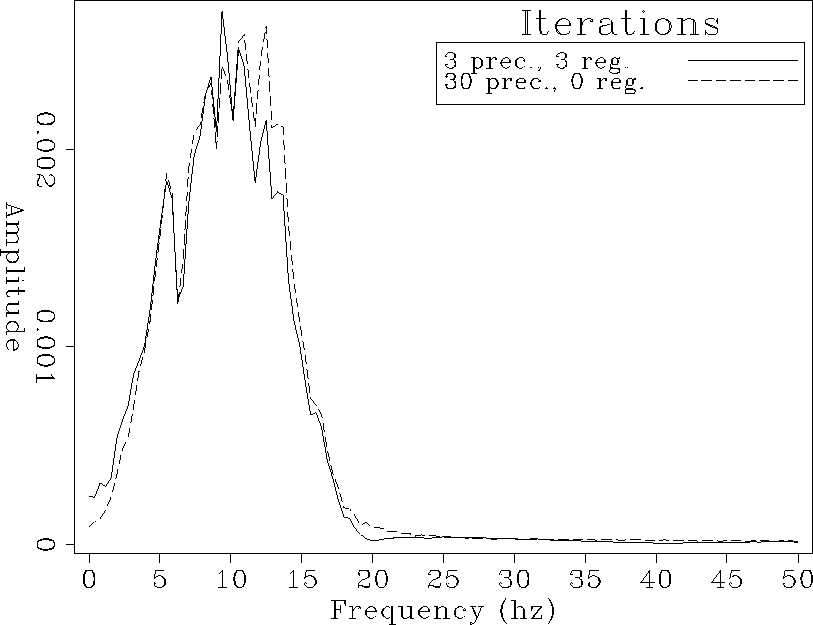 |
Figure displays the models resulting from the ``best''
solution and the solution using 30 iterations of preconditioned inversion.
The model resulting from 30 iterations has done a better job of filling the
areas affected by the null space, as we would expect for an inversion process that
used 5 times as many iterations. I have also included a model that has filled the
areas affected by the null space equally well as that used only regularized inversion
(fitting goals ()). This result took 50 iterations.
 |