


Next: The data
Up: Constructing an interpolation problem
Previous: Constructing an interpolation problem
In order to examine the results of preconditioned inversion, regularized
inversion,
and my proposed CIPR, I needed a problem that was easier to understand
than that shown in (). I am concerned with two issues:
frequency content and solutions at every model point. To address the first issue,
I chose to make my inversion operator a ``smoother'' that causes the model to have
a higher frequency content than the data. This can be expressed as:
|  |
(120) |
where  is the data,
  is the model, and
  is a smoothing
operator that maps the average of 5 vertical points in the model to one point in
the data. Since the model should be high frequency, the effects of the
preconditioned inversion should be quite obvious.
is a smoothing
operator that maps the average of 5 vertical points in the model to one point in
the data. Since the model should be high frequency, the effects of the
preconditioned inversion should be quite obvious.
Given such a simple inversion operator, creating a need for regularization or
preconditioning requires that I cause the model created by inversion (fitting
goal (![[*]](http://sepwww.stanford.edu/latex2html/cross_ref_motif.gif) )) to have points that do not have solutions defined by the
inversion operator. I chose to do this by introducing a masking operator
)) to have points that do not have solutions defined by the
inversion operator. I chose to do this by introducing a masking operator  .The combined operator
  will now have a null space where
  .This changes my fitting goal to:
|  |
(121) |
To interpolate the model in the areas affected by the null space,
I add a second fitting goal to fitting goal ():
|  |
(122) |
| |
where the new operator,  , is a regularization operator. I have chosen
to make a steering filter (, )
generated as described in (, ).
Briefly, a steering filter consists of dip penalty filters at every model point,
meaning that it is a non-stationary roughening operator that acts over
short distances.
To precondition this problem, I perform a change of variables to replace the
model with the preconditioned variable
, is a regularization operator. I have chosen
to make a steering filter (, )
generated as described in (, ).
Briefly, a steering filter consists of dip penalty filters at every model point,
meaning that it is a non-stationary roughening operator that acts over
short distances.
To precondition this problem, I perform a change of variables to replace the
model with the preconditioned variable  :
:
|  |
(123) |
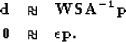
Applying this to fitting goals () results in a new set of fitting goals:
|  |
(124) |
| |
The inverse of the steering filter ( ) is applied using the helix
transform. The inverse operator will be a smoothing operator that will act
over a much larger distance than .
) is applied using the helix
transform. The inverse operator will be a smoothing operator that will act
over a much larger distance than .
Next: The data
Up: Constructing an interpolation problem
Previous: Constructing an interpolation problem
Stanford Exploration Project
11/11/2002