


![[*]](http://sepwww.stanford.edu/latex2html/cross_ref_motif.gif) , Kirchhoff
methods are normally used when performing migration velocity analysis.
As in the previous chapters, I chose instead to use a wave
equation method to construct my CRP gathers.
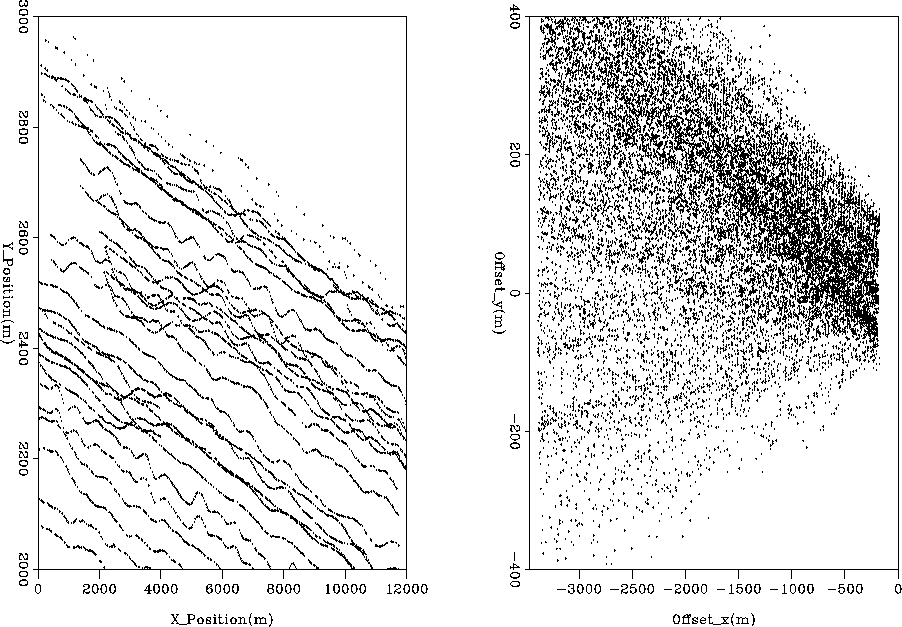
Figure 1 shows source locations and
offset-azimuth distribution for
a portion of the L7D dataset.
The irregularity of both domains imposes
a problem.
Wave equation methods require the data to be on a regular mesh.
There are several methods to regularize the geometry with the usual
tradeoff of accuracy vs. cost. Two common choices are
relatively inexpensive: partial stacking () and
the more accurate Azimuth Moveout (AMO) introduced by ().
, Kirchhoff
methods are normally used when performing migration velocity analysis.
As in the previous chapters, I chose instead to use a wave
equation method to construct my CRP gathers.
Figure 1 shows source locations and
offset-azimuth distribution for
a portion of the L7D dataset.
The irregularity of both domains imposes
a problem.
Wave equation methods require the data to be on a regular mesh.
There are several methods to regularize the geometry with the usual
tradeoff of accuracy vs. cost. Two common choices are
relatively inexpensive: partial stacking () and
the more accurate Azimuth Moveout (AMO) introduced by ().
AMO is a partial migration operator and can be thought of as a cascade of Dip Moveout (DMO) () and inverse DMO (). It attempts to construct data at a given offset-azimuth pair by applying a relatively small, and therefore relatively inexpensive, operator. AMO can construct regularly sampled data from the irregular trace locations shown in Figure 1. In this chapter I will be using the regular data cube constructed by (). In the process of performing AMO the dataset was resampled. The resampled dataset had CMP spacing of 20m in the inline and 25m in the crossline. The offset range was resampled to 50m ranging from 200m to 3400m.
 |


