


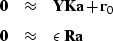
Interpolating with adaptive PEFs means calculating a large volume of filter coefficients. It is possible to estimate all these filter coefficients by the same formulation as in the previous chapter, supplemented with some damping equations, like
 |
(23) | |
| (24) |
 is a roughening operator,
 is convolution with the data,
and
is convolution with the data,
and  is an adjustable filter coefficient selector.
does not roughen between coefficients within a single filter,
but between coefficients at the same lag in different filters.
is an adjustable filter coefficient selector.
does not roughen between coefficients within a single filter,
but between coefficients at the same lag in different filters.
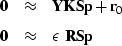
When the roughening operator is a differential operator,
the number of iterations can be large.
To speed the calculation immensely,
we can precondition the problem.
Define a new variable  by
by
 and insert it into (
![[*]](http://sepwww.stanford.edu/latex2html/cross_ref_motif.gif) ) and () to get
) and () to get
 |
(25) | |
| (26) |
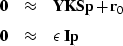
 by
by  and get
 |
(27) | |
| (28) |
using conjugate gradients.
To get  , just use .Once is calculated, the missing traces are filled in as before.
To simplify the formulation, one could
drop the damping ()
and keep only ();
then to control the null space,
start from a zero solution and just limit the number of iterations.
This is the way most of the examples later in this
chapter are calculated.
, just use .Once is calculated, the missing traces are filled in as before.
To simplify the formulation, one could
drop the damping ()
and keep only ();
then to control the null space,
start from a zero solution and just limit the number of iterations.
This is the way most of the examples later in this
chapter are calculated.
Previously we solved for the PEFs , which have a fixed
coefficient that is defined to have the value 1.
We instead estimate , which is related by .It appears troublesome that we do not
necessarily know the fixed coefficient of .We can begin by applying  ,putting some other value in the fixed coefficient of ,that will be integrated by
  to give 1's.
But it is a hassle to then apply to the data because
our software has the value 1 built in.
Luckily, the problem disappears by itself.
Wherever the forward operator is applied, it looks like
to give 1's.
But it is a hassle to then apply to the data because
our software has the value 1 built in.
Luckily, the problem disappears by itself.
Wherever the forward operator is applied, it looks like
 , which is the same as
 .We only need to apply to the adjustable coefficients of ,because we know the fixed coefficient of
  equals one, even
if we do not know the fixed coefficient of .We do not need to know or store the fixed coefficients of .
equals one, even
if we do not know the fixed coefficient of .We do not need to know or store the fixed coefficients of .