


Here, I consider the simplest and probably most practical anisotropic model, that is, a transversely isotropic (TI) medium with a vertical symmetry axis. Although more complicated kinds of anisotropies can exist (i.e., orthrohombic anisotropy), the large amount of shales present in the subsurface implies that the TI model has the most influence on P-wave data Banik (1984).
In homogeneous transversely isotropic media with a vertical symmetry axis (VTI media),
P- and SV-waves![[*]](http://sepwww.stanford.edu/latex2html/foot_motif.gif) can be described by the vertical velocities
VP0 and VS0 of P- and S-waves, respectively, and two
dimensionless parameters
can be described by the vertical velocities
VP0 and VS0 of P- and S-waves, respectively, and two
dimensionless parameters  and
and  Thomsen (1986).
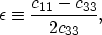

, and .Alkhalifah and Tsvankin (1995) further demonstrated that a new representation in terms of just two parameters is sufficient for performing all time-related processing, such as normal moveout correction (including non-hyperbolic moveout correction, if necessary), dip-moveout correction, and prestack and post-stack time migration. These two parameters are the normal-moveout velocity for a horizontal reflector
 |
(1) |
 ,
,
 |
(2) |
 , I will use v
to represent the interval NMO velocity in both isotropic and TI media. The midpoint-offset
traveltime equations, like any other
time-domain equations, are expected to be dependent on these to parameters as well.
, I will use v
to represent the interval NMO velocity in both isotropic and TI media. The midpoint-offset
traveltime equations, like any other
time-domain equations, are expected to be dependent on these to parameters as well.