


The extension of f-x prediction into three dimensions is more difficult than
that of t-x prediction.
For each frequency,
instead of a prediction along a vector,
the prediction
of a set of complex numbers within a plane is required.
For the examples of 3-dimensional f-x prediction shown here,
I computed a complex-valued 2-dimensional
filter at each frequency
with a conjugate-gradient routine.
While other techniques for computing this filter
exist,
they should produce similar results.
The advantage of this approach is that the huge
matrix  used to describe
the 3-dimensional convolution of the filter with the
data does not need to be stored, and the inverse of
used to describe
the 3-dimensional convolution of the filter with the
data does not need to be stored, and the inverse of  does not need to be computed,
which simplifies the problem
significantlyClaerbout (1992a).
does not need to be computed,
which simplifies the problem
significantlyClaerbout (1992a).
The shape of the 2-dimensional filter used to predict numbers in a 2-dimensional frequency slice has the form
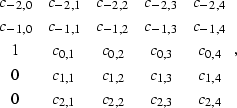 |
(71) |
![[*]](http://sepwww.stanford.edu/latex2html/cross_ref_motif.gif) . If the collection of the
filters for all frequencies is Fourier transformed in time, a filter
similar to the one shown in Figure ,
but extended in time,
is formed.
. If the collection of the
filters for all frequencies is Fourier transformed in time, a filter
similar to the one shown in Figure ,
but extended in time,
is formed.