


The problem of calculating a prediction-error filter  can be set up
by describing the convolution process
as a matrix multiplication
can be set up
by describing the convolution process
as a matrix multiplication  .The matrix
  is made up of shifted versions
of the signal
is made up of shifted versions
of the signal  to be multiplied by the filter vector as shown below.
If is perfectly predictable, a filter will be calculated
to give a result of zero,
to be multiplied by the filter vector as shown below.
If is perfectly predictable, a filter will be calculated
to give a result of zero,  .
With most real data,
will not be perfectly predictable,
and the result of will not be zero, but
.
With most real data,
will not be perfectly predictable,
and the result of will not be zero, but  ,where
  is the error or unpredictable part.
This error is minimized to get the desired .The idea of an imperfect prediction
may also be expressed as a system of regressions,
where
is the error or unpredictable part.
This error is minimized to get the desired .The idea of an imperfect prediction
may also be expressed as a system of regressions,
where  .
.
Here, I will show the traditional method of setting up
a one-dimensional prediction-error filter calculation problem.
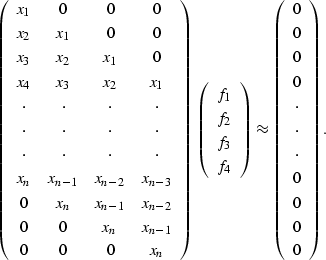
The linear system , expanded to show its elements, is
 |
(41) |
Notice how the matrix is made up of the vector
shifted against the filter to produce the convolution of and .At least one element of is constrained to be non-zero to
prevent the trivial solution where all elements of are zero.
In this case, f1 is constrained to be one
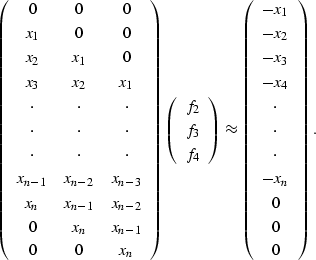
so we can modify the equation above to move the constrained portion to the
right-hand side to get
 |
(42) |
 , and the set of filter coefficients without f1 will
be referred to as
, and the set of filter coefficients without f1 will
be referred to as  .The system to be solved is then
  .Using the normal equations, the solution for becomes
 .
. is the autocorrelation matrix,
which is also referred to as the inverse covariance matrix.
The reason for calling an
autocorrelation matrix is obvious, since the rows of the
matrix are the shifted autocorrelation of .The description of
is the autocorrelation matrix,
which is also referred to as the inverse covariance matrix.
The reason for calling an
autocorrelation matrix is obvious, since the rows of the
matrix are the shifted autocorrelation of .The description of  as a covariance matrix
comes from the idea that is a function of random variables.
The relationship between the values of at various lags are
described by the expectation E of the dependence of the values of
with different delays.
This is expressed as E(xi xj), where i and j are indices
into the series .If the expectation E(xi xj) is zero when
as a covariance matrix
comes from the idea that is a function of random variables.
The relationship between the values of at various lags are
described by the expectation E of the dependence of the values of
with different delays.
This is expressed as E(xi xj), where i and j are indices
into the series .If the expectation E(xi xj) is zero when  ,the spectrum of would be white,
and the sample values of would be unrelated to each other.
The autocorrelation would be zero except at zero lag.
,the spectrum of would be white,
and the sample values of would be unrelated to each other.
The autocorrelation would be zero except at zero lag.
The solution for requires storing only the autocorrelation of and can be solved quickly and efficiently using Levinson recursion.
Once again, the efficiency of this technique depends on
being Toeplitz, which in turn depends on the type of
convolution being transient, rather than internal or truncated-transient.
When is not Toeplitz, it can still be solved
using techniques such as Cholesky factorization,
but at a higher cost of storage and calculation.