


In this thesis,
the emphasis will be on signal processing aspects of inversion.
The problems to be dealt with will be time series or collections
of time series.
A single time series, referred to as a trace,
generates a one-dimensional problem.
A collection of traces generates multi-dimensional problems.
The data recorded  will be analyzed to produce some information
about the reflection series
will be analyzed to produce some information
about the reflection series  .The series may also be considered to be the error
in the expression
.The series may also be considered to be the error
in the expression  , where
  is a filter that is designed
to remove predictable information.
Therefore, the reflection series is assumed to be the unpredictable
part of the series .The data is assumed to be stationary, Gaussian, and have
a zero mean.
Stationarity means that the the statistical character of the data
does not change in time.
This means that any statistical measure is expected to be
unchanged if the trace is shifted.
This assumption can be enforced by windowing
the data so there are no large character changes within a window.
The assumption of a Gaussian distribution might be more difficult
to confirm but is still reasonable,
since errors that are the result of some kind of summation
tend to have Gaussian distributions.
The zero mean is generally not a problem,
since seismic data normally have had some kind of filter applied,
and there is no reason to assume that the errors have a bias.
is a filter that is designed
to remove predictable information.
Therefore, the reflection series is assumed to be the unpredictable
part of the series .The data is assumed to be stationary, Gaussian, and have
a zero mean.
Stationarity means that the the statistical character of the data
does not change in time.
This means that any statistical measure is expected to be
unchanged if the trace is shifted.
This assumption can be enforced by windowing
the data so there are no large character changes within a window.
The assumption of a Gaussian distribution might be more difficult
to confirm but is still reasonable,
since errors that are the result of some kind of summation
tend to have Gaussian distributions.
The zero mean is generally not a problem,
since seismic data normally have had some kind of filter applied,
and there is no reason to assume that the errors have a bias.
The reflection series, or error ,produced from the filtering operation is also assumed
to be stationary, Gaussian, and have
a zero mean,
but in addition, the samples of the errors are assumed to be independent
from the other samples in .These assumptions may be better described by expectations.
The errors may be considered to be realizations of a random process drawn from a population, or ensemble. The expectation of a function of a random variable x is expressed as
![\begin{displaymath}
E[f(x)] = \int_{-\infty}^\infty f(x) \varphi(x) dx\end{displaymath}](img53.gif) |
(17) |
 is the probability densityKorn and Korn (1968).
In the discrete case
is the probability densityKorn and Korn (1968).
In the discrete case
![\begin{displaymath}
E[f(x_i)] = \sum_i f(x_i) p_{x_i},\end{displaymath}](img55.gif) |
(18) |
For the errors and the data ,the assumption of a zero mean is expressed as
![$E[\sv r]=0$](img56.gif) and
and ![$E[\sv d]=0$](img57.gif) .The assumption that the samples of are uncorrelated
becomes
.The assumption that the samples of are uncorrelated
becomes ![$E[\sv r \sv r^{\dagger}] = \sigma_r^2 \st I$](img58.gif) ,
where
,
where  is the identity matrix,
and
is the identity matrix,
and  indicates the
conjugate transpose, or adjoint.
The dependence of the data values on each other is expressed
as
indicates the
conjugate transpose, or adjoint.
The dependence of the data values on each other is expressed
as ![$E[\sv d \sv d^{\dagger}] = \st V$](img60.gif) ,where
,where  is the covariance matrix.
The Gaussian distribution of and may be expressed
as
is the covariance matrix.
The Gaussian distribution of and may be expressed
as 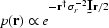 and
and 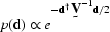 ,where
  is a scalar and is the identity matrix.
Notice that these probability functions are
distributions that satisfy the zero mean assumption.
Also note that the independence of the samples in the errors
is seen in the
is a scalar and is the identity matrix.
Notice that these probability functions are
distributions that satisfy the zero mean assumption.
Also note that the independence of the samples in the errors
is seen in the  factor in
  ,whereas the dependence of the data samples is seen in the
inverse covariance matrix
,whereas the dependence of the data samples is seen in the
inverse covariance matrix  in
in  .
.