


![[pdf]](icons/pdf.png)
|
|
|
|
| Random boundary condition for low-frequency wave propagation | |
|
|
|---|
|
velfullrndbnd
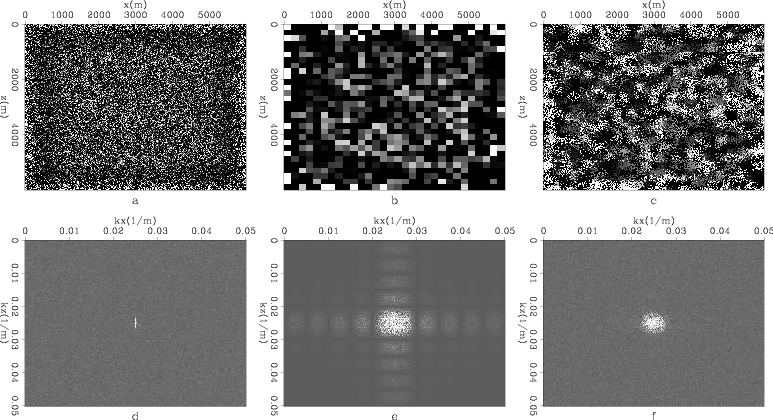
Figure 6. Velocity field with different random boundaries: a) cubic grains with  m length; b)cubic grains with
  m length; and c) randomly shaped grains with
m effective length. The bottom row shows their corresponding
m length; and c) randomly shaped grains with
m effective length. The bottom row shows their corresponding  spectra: d) cubic grains with
m side length, e) cubic grains with
m side length, and f) randomly shaped grains with
m effective length. [ER]
spectra: d) cubic grains with
m side length, e) cubic grains with
m side length, and f) randomly shaped grains with
m effective length. [ER]
|
|
|
Another way to analyze the previous two examples is to consider the spectra of different random boundaries. Figure 6 shows a velocity field filled with different random boundaries. We can look at their
spectra by Fourier transform along both the  and
and  axes and take the absolute amplitudes (Figure 6). It can be seen that randomly shaped grains at high
values have an amplitude similar to that of single-cell random boundary, and at low
values have an amplitude similar to that of a large cubic-grain random boundary. The large cubic-grain random boundary, on the other hand, has a far lower high-
component, and there are even notches at certain
values. These features become obvious in stacked
axes and take the absolute amplitudes (Figure 6). It can be seen that randomly shaped grains at high
values have an amplitude similar to that of single-cell random boundary, and at low
values have an amplitude similar to that of a large cubic-grain random boundary. The large cubic-grain random boundary, on the other hand, has a far lower high-
component, and there are even notches at certain
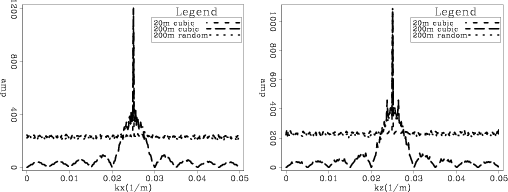
values. These features become obvious in stacked  and
and  spectra of each random field (Figure 7). Large amplitude at high
values means more detailed randomness, which is useful for scattering high-frequency waves. Large amplitude at low
values means many coarse ``grains'', which is useful for scattering low-frequency waves. Random fields that have both can effectively scatter broadband signals, and this is the case for randomly shaped grains. The large volume of the grains effectively scatters low-frequency signals, while the edges of grains effectively scatter high-frequency signals. On the other hand, regular notches in the spectrum mean that the random field (cubic grains in this case) displays certain patterns that will render it unable to deal with certain wavefronts; this is analogous to the null space in inversion.
spectra of each random field (Figure 7). Large amplitude at high
values means more detailed randomness, which is useful for scattering high-frequency waves. Large amplitude at low
values means many coarse ``grains'', which is useful for scattering low-frequency waves. Random fields that have both can effectively scatter broadband signals, and this is the case for randomly shaped grains. The large volume of the grains effectively scatters low-frequency signals, while the edges of grains effectively scatter high-frequency signals. On the other hand, regular notches in the spectrum mean that the random field (cubic grains in this case) displays certain patterns that will render it unable to deal with certain wavefronts; this is analogous to the null space in inversion.
|
|---|
|
vkabsstk
Figure 7. Stacked
and
spectra of each random field obtained by stacking the amplitude
spectrum along the
and
directions. On the left is the
spectrum; on the right is the
spectrum. The blue is from cubic grains of side length
m, red is from cubic grains of side length
m, and pink is from randomly shaped grains of length
m. [ER]
|
|
|
|
|
|
|
| Random boundary condition for low-frequency wave propagation | |
|