


![[pdf]](icons/pdf.png)
|
|
|
|
| Random boundary condition for low-frequency wave propagation | |
|
|
|---|
|
srctwentyfive
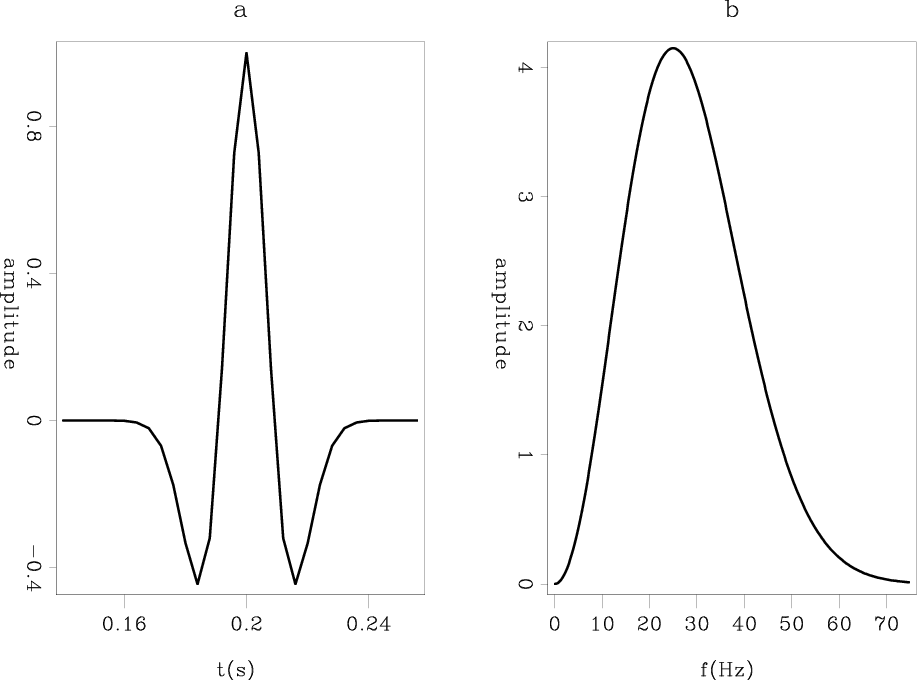
Figure 4. Time-domain and frequency-domain broadband source with a peak frequency of  Hz: a) Time-domain wavelet; b) Frequency-domain amplitude spectrum. [ER]
|
|
|
|
|---|
|
wvmvtwentyfivehoriz
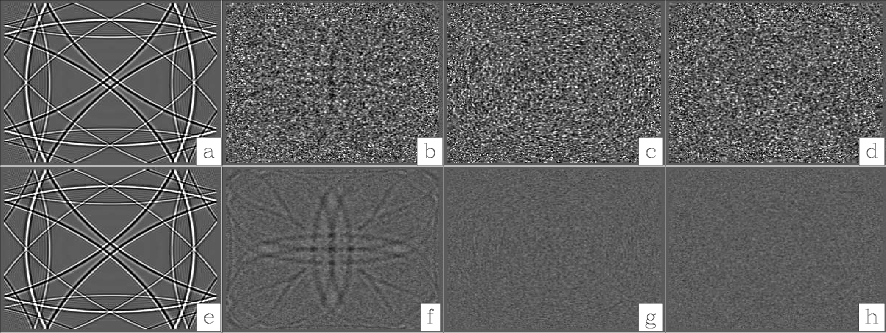
Figure 5. Time domain wavefield snapshots for a broadband point source with a peak frequency of
Hz, in velocity fields with different random boundary conditions. The top row shows one realization of velocity with a) constant velocity, b) cubic grains with  m side length, c) cubic grains with
  m side length, and d) randomly shaped grains with effective length
m. The bottom row shows average wavefields using
m side length, and d) randomly shaped grains with effective length
m. The bottom row shows average wavefields using  realizations of velocity with e) constant velocity, f) cubic grains with
m side length, g) cubic grains with
m length, and h) randomly shaped grains with effective length
m. [CR]
realizations of velocity with e) constant velocity, f) cubic grains with
m side length, g) cubic grains with
m length, and h) randomly shaped grains with effective length
m. [CR]
|
|
|
In this section, we test a broadband point source with a peak frequency of
Hz, using the same boundary as in the previous example. Figure 4 shows the amplitude spectrum of the point source used, which contains non-trivial high- and low-frequency components. Figure 5 (top row) shows 2D slices of the wavefield using one realization of each velocity. In this case, the proposed random boundaries still work quite well. A random boundary with a small grain size is effective at high frequency, but has difficulty eliminating low-frequency components of the source. This is more obvious in the bottom row of Figure 5, which is the stacked wavefield of the same source and record time, using
different realizations of random boundaries.
|
|
|
|
| Random boundary condition for low-frequency wave propagation | |
|